Cezanne , Undergrowth, 1894, LACMA, (detail)
After “Picasso and Chicago” (2013) and “Monet and Chicago” (2020), it seemed likely that a Cezanne exhibit at the Art Institute would also be limited to local collections. Happily, however, this one has pulled in pieces from all over the world - even if some of the best come from the museum’s very own walls.
Paul Cezanne (1839-1906) is now best known for his place in the history of modernism. As you approach the exhibit, signage proclaims: “He upended the conventions of European painting, laying bare the components of color and brushwork used to create images”. There’s no mention of his famous quote about the “cylinder, sphere, and cone” - but you get the idea. Cezanne’s great contribution to painting was technical/theoretical.
As you enter to face the first painting, adjacent signage informs us that “it shows Cezanne radically rethinking the conventions of landscape with a vertical format covered by a web of entangled lines that extend beyond the canvas.” True enough - but that painting, “Undergrowth (1896), is also a brilliant explosion of shimmering color swept into a vortex of collapsing pictorial space. It’s a shower of pleasure which, by itself , would well be worth the price of admission.
Curators may have marginalized the aesthetic impact of a Modernist master to suit a theory driven, post-modernist academy - but they also chose the most ecstatic piece to place by the entrance - and invited ten contemporary artists to comment on individual paintings - a commentary that usually responds to subject matter or aesthetic effect. It’s a convincing demonstration of Cezanne’s ongoing aesthetic impact more than a century after his death.
And paintings can always speak for themselves anyway. What these paintings tell us, as the eponymous title of this exhibit might suggest, is that Cezanne’s primary subject was himself. As gallery signage quotes him up on the wall: “I paint as I see, as I feel, and I have very strong sensations”. The trees, nudes, or apples in front of his eyes were not depicted so much as they were transformed into a personal, emotive vision - driven, it seems, by some burning existential query.
His marks may be perfect for the overall form he is developing - but often they are unconnected to any detail in the subject. Everything feels laborious - because that’s how he was. And he was a loner - passionately devoted to pleasing no one but himself. All of which made so many of his figurative pieces problematic. As Peter Schjeldahl once noted, his portraits are “lurchingly uneven” and may be “clunkers”. To me, most of the Bathers just feel silly. But there are a few remarkable exceptions. The portrait of his wife in a yellow chair is a highlight of the Art Institute’s permanent collection. The portraits of his gardeners display great admiration for their quiet masculinity - and his solitary male bather erupts from the wall, later inspiring the young Pablo Picasso to paint the same figure walking a horse. It was female nudes that gave him the most trouble. He knew that great European artists are supposed to paint them, but out of either shame or lack of desire, he apparently did not know how he really felt about female flesh.
His still lifes reveal a passion for color, pictorial space, and other elements of graphic design. But what he really loved was sunlight on the hills, trees, and mountains of his native southern France. He also loved the villages - though only from an aerial view. Apparently he was not so fond of walking streets where he might have to greet someone.
As research has shown, even the “how to paint” guidebooks of his day “ laid bare the components of color and brushwork” Meanwhile “the conventions of European painting” were continuously being overturned in 19th century Paris - and before that as well. What really set Cezanne apart was a stubborn self possession that made him as marginal to the artworld of his day, as it makes him crucial to so many artists of our time. Contemporary artists need pledge no allegiance to church or state. Cezanne was the great pioneer of a self expression that’s worth looking at. He could be called an “outsider artist”, except that he trained in an academy and haunted the Louvre. Possibly that’s why his eccentricity endures.
***********************************************************************************
I wonder what this landscape would have looked
like to us without colonization? Would we care
about Cezanne or his work? Better yet, would
there even be a "Cezanne" without colonization?
Would it matter that he broke up the picture
plane? Would the idea of a picture plane even be
an issue? How would we register the light between
the branches? Could he have surveyed the land,
creating a disintegrating picture plane, if he was
unaware of the disintegration happening on his
and his countrymen's behalf in the likes of Algeria,
the Congo, Vietnam, and the rest of France's
colonies? I don't know if Cezanne had put two and
two together. But how do you just see the formal
properties of a painting or the scholarship or the
invention his work evokes without foregrounding
that history?
-ARTIST RODNEY MCMILLIAN
It’s good to challenge the primacy of the "disintegrating picture plane" in contemporary discussions of Cezanne, but the bold privileging of politics over aesthetics suggests that the "we" invoked here is the politicized academic community to which the writer belongs. But has any other academic ever linked the disintegration of the picture plane to the destructive effects of colonization? Has even Mcmillian himself ever published a paper about it ?
Was French imperialism somehow less destructive back when it was colonizing North America in the centuries before Cezanne? Has any civilization, going back to Old Kingdom Egypt not disintegrated the many social systems whose people they eventually incorporated? This is the problem with foregrounding history over aesthetic: it impedes the direct experience of an historical object with a discourse that is always debatable and in this case just provocative nonsense.

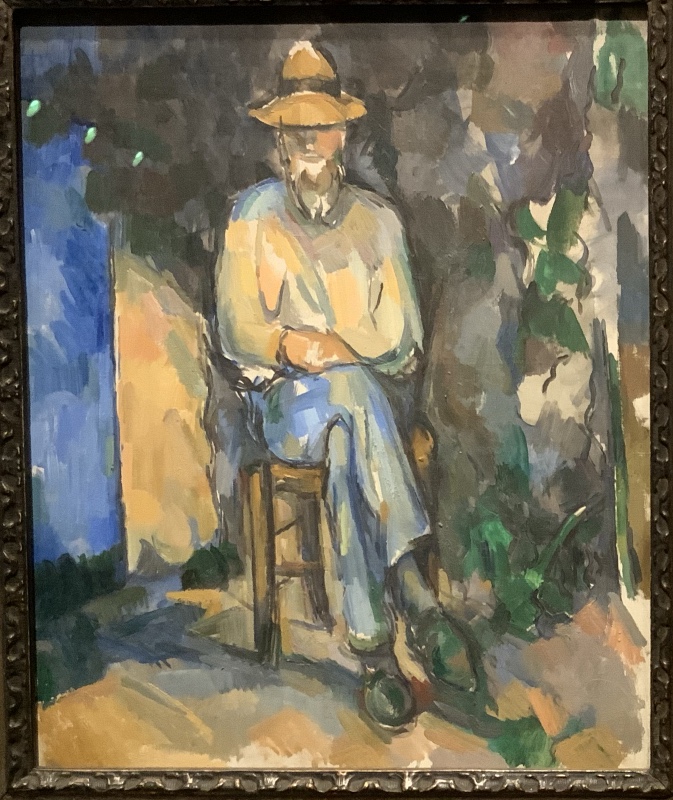
Cezanne : The Gardener Vallier, c. 1906
..Etel Adnan (1925-2021)
I’d never heard of this poet-philosopher-painter —- and really enjoyed discovering her abstract paintings. They are so uplifting. It’s no surprise Cezanne was comfortable with his gardener - he was a servant - he did the master’s bidding - presumably effectively and without complaint.
Cezanne : Sea at L’Estaque behind trees, 1878-79 (from the Museo Picasso)
Lessons I find for the future painter No part of
your picture is autonomous, or even a solid fact.
Every plant and house you paint has a mirrorlike
surface, a refracted symmetry, míni-tricornered
and ovalish framed paintings hinged together
Two trees obstruct, contain, and surround both
the water and the sky.
X marks imply the start of an open weave, an
aborted grid. It is without regularity that the
lines carve the sea, but each sideways cat's-eye,
triangle, and brushstroke has a twin or cousin of
varying size. Mirroring the left and right or top
and bottom like an unfolded piece of origami,
these flattened shapes remember space......Laura Owens
I really like this painting - it's unfailingly energetic and inventive - like some kind of puzzle.
I also like Owens as both painter and writer about painting. Too bad that none of her writings appear on her website.
Cezanne : Bathers , 1899-1904
Cezanne's bathers seem at ease with themselves
They look pleased by simply being, enlivened by
their surroundings and by each other, enjoying
themselves without guilt, aggression, or fear. What
I like most about looking at his bathers ... is how
they remind me of what it feels like to be renewed.
Perhaps this feeling also reflects the notion that
water represents a source of life, an instrument of
cleansing, and a means of regeneration in virtually
all cultures, is this why I so strongly correlate the
bathers motif with the notion of renewal?……Paul Chan
An interesting response - quite different from my own.
Cezanne, Three Skulls, 1902-6
Each absent place an eye should be
drinks-in
the spectrum of its circumstance:
thin'd red with blue
marks one
against a yellow'd pool
the other five make what they will
from annotated variants:
sparks or faded notes of green
gray'd-blues
indigos with cobalt-bits
water'd sepias
blotched-pinks from red
ochre'd mauves and violets.
Each absent nose inhales
an ever-shaded-palette-scent.
Each brush-marked gap
proposes "inside-ness"
invokes a dome we cannot see:
where thought and recollection
once prevailed.-JULIA FISH
Love that first phrase about the empty eye sockets - though neither this piece nor Fish’s paintings especially appeal to me. Life and death are indeed a cycle. The one does not exist without the other. But still I am exclusively interested in life. It’s so much more exciting.
Cezanne, Scipio, 1866-68
.
-ELLEN GALLAGHER
A dark and sad piece - but appropriate, one presumes, for the subject matter: a former slave showing off the whip marks on his back.
"introducing buried time to Western painting" is presumably intended as a provocative overstatement.
Cezanne : Madame Cezanne , 1888-90
This painting does not conform to the brick-by-
brick pattem of colored planes generally agreed
to reflect Cezanne's method but is rich with many
of the formal Idiosyncraties we take for granted as
being his today. Sections of the picture alterate
between flatness and volume. Edges and contours
are established, then disappear. Foreground objects
and the background alternately overlap and merge. Continuous forms are misaligned from one side of a
shape to the other. These are among the peculiar,
yet deliberate, inconsistencies that give Cezonne's
painting its vitality and contribute to an inexhaustible sense of fascination.
_-KERRY JAMES MARSHALL
Hannah Edgar (linked below) calls this a "geek out about the use of perspective" -- - and it does entirely avoid both subject matter and aesthetic impact in favor of. "peculiar yet deliberate inconsistencies".
Is that what gives his work vitality - or just it’s connection to the personality who made it ?
*******
*******
*******
Hannah Edgar of The Chicago Tribune reviewed the show
here.
The first thing that struck her was the curator’s decision to drop the aigu accent from the artist’s name (in deference to his origins in the south of France). She also tells us that the exhibit is rather disorganized- much like the bramble depicted in "Undergrowth", the painting shown at the top of this post. She’ s a fine writer, but not very sensitive to visual art. Her real specialty is music. I’m so glad the Trib finally took got rid of John Kass - but otherwise, after so many corporate takeovers, the paper appears to be on life support.
Self portrait with pink background, 1875
Dmitry Samarov’s review
in the Chicago Reader is the best local art criticism I can remember ever reading. (but then it my memory is fading - and so little good ever gets written about art )-
Ignoring gallery signage and art theory, his review is just his own, personal confrontation with the artist based on his lifetime of experience with painting.
Like me, he’s appalled by Cezanne's female nudes - and that is rather provocative - especially since this exhibition presents the "Bathers" as the pinnacle of Cezanne’s career. I cannot imagine any major art magazine publishing such a dissenting opinion.
Unlike me, his favorite portrait/figure is the self portrait with pink background. He likes that it boldly presents an unlikable character. I dislike that it gives me indigestion.
Cezanne : Paris Rooftoops, 1882
Dmitry Samarov
And Dmitry's piece is just as good.
It’s a vision that centers subjectivity, motion, and change, rather than stability, hierarchy, or order. Probably no coincidence that he worked out his methods at the same time when Nietzsche was killing God. Nobody who believes in a benevolent creator fashioning and guiding the universe could see their surroundings in the slippery and undependable way Cézanne saw his
Roualt, Head of Christ,1937
Roualt might be a counter example, though actually, Cezanne himself could be a counter example since he was known as a devout Catholic.
Not all the faithful see "stability, hierarchy, and order" in the divine.