Saturday, September 30, 2023

George Petrides at National Hellenic Museum


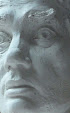
George Petrides, Man Between TwoWars, 2022


There are many ethnic cultural spaces in Chicago - yet only a few are serious about visual  art. ( hats off to the Ukrainians and Mexicans ! ). Now, ten years after the National Hellenic Museum built a gorgeous new facility in Greektown— perhaps it is finally going to give more space to art exhibition.


This show consists of six monumental bronze-like heads - each on its own pedestal with explanatory signage.  They tell the story of the artist’s Greek ancestors - mostly in the 20th Century:  how they fled Smyrna when it fell to the Turk and then began building new lives elsewhere. The dark, lumpy, dimly lit, monstrous busts depict it as a story of loss, pain, and endurance -  most notably, and almost heroically, in the self portrait shown at the top.


Rodin, Head of Pierre  de Wissant, 1885-6

Signage for that self portrait refers to a detail from Rodin’s Burghers of Calais - one of whose many variants is shown above. Petrides is certainly swinging for the fences in both the scope of his theme and the sculptural tradition he invokes to address it.  But does  he really hit the ball  into the grandstands?

This work is not in the heroic/natural tradition of Pheidias, Michelangelo, or Rodin. It does not amaze with a conflation of convincing mimesis and formal power.  But it does project strong feeling - much like the works of an expressionist sculptor like Giacometti - who is also mentioned in gallery signage. The pieces in this show feel far less isolated, insecure, and borderline wacky than  those of the  artworld icon of the mid-20th Century - and that’s not a bad thing.  Existential angst was trending  back then - nowadays it’s been replaced by tribal victimization.

  The 2016 exhibit of Theaster Gates at Richard Gray comes to mind, though Greek identity is far less relevant than African to today’s artworld.  Petrides work is also much more personal and nostalgic.   Both artists, however, invoke a great tradition of sculpture…. yet only to establish ethnic identity as they plead sympathy for ethnic trauma.   The greatness of the past is but a dim, fading memory.

************


Regarding materials:

New City reports that the artist used  "epoxy clay, plastic, metals and custom patinas" … while referring to his practice in general, the artist himself says that "each piece cast in bronze using the same lost-wax methods that were used by the ancient Greeks, with expressive patinas applied by hand and torch."  Gallery signage reads "mixed media including bronze and custom patinas"

Epoxy clay has no role in the bronze casting process… so I’m guessing that it was applied to a foam core and mixed with - or covered by - metallic bronze powder.  The results can resemble bronze at about a tenth of the cost.


Wednesday, September 20, 2023

Anna Kunz at McCormick Gallery


Masterpieces of spiritual art can also be quite decorative.  Think of all those graceful Buddhas in the living rooms of upscale, non-Buddhist Americans.  While decorative art, like ceramic ornamental tiles, can appear on the walls of mosques as well as private homes.   But still …..can’t we distinguish between what makes one feel good - and what jolts the soul like a divine revelation?

Both kinds of Anna Kunz paintings  can now be seen in McCormick Gallery - but curiously enough,  it’s only the decorative ones that  are in the featured exhibit of smaller pieces called "Rosy".  The larger, more impressive pieces are in the back rooms of inventory.

Size doesn’t really matter.  Think of the amazing four-inch paintings by Nicholas Sistler .  The abstract watercolors of A.R. Ammons that came to the Poetry Center a few years ago were not much larger than the 11x13" pieces in this show -  yet what an amazing impact they had.  Most of the 30 small oil paintings pieces in "Rosy’ do no more than demonstrate the artist’s commendable skill and taste - while the half-dozen watercolors are just puzzling,  Kunz achieves luminosity so well in her oils - so why do her watercolors feel so dark and gloomy? Is that really what she was aiming for?


11" x 13"


A few of these small pieces, however, like the one above, really do proclaim the joy of paint as it registers shape, rhythm, hue and luminosity.  It recalls  the strength and delicacy of an earlier Chicago abstractionist, Miyoko Ito, though with a spirituality that’s more European than Japanese.


Anna Kunz, Well, 2023, 53x53"

This large piece, found in a back room, is even more emphatic in its connection to traditional European religion.  It draws the viewer in to a glowing center of divine revelation.  These are pieces that belong in a chapel not a dining room or corporate office.  It needs equally inspired architects to design such a space - like those who created the Rothko chapel.  If only our local billionaires were as committed to aesthetics as much as right wing politics.


********************


In his New City review, Alan Pocaro  is  more concerned with the idea of color than whatever emotional, spiritual, or narrative effect these particular colors may have. He does call the pieces "Ernest and poetic", but he does not elaborate on the content of that poetry or find any qualitative difference between the oils, watercolors, and the dyed hanging fabric.  Given their prices ($6000 each) I was reluctant to call these small pieces studies - but Alan correctly identifies them as such ( as confirmed by gallery website text that refers to them as "foundational pieces that ground her studio practice and inform her larger canvases and installations." 


Monday, September 4, 2023

Tom Torluemke at UIMA


Contemporary observational landscape paintings are turning up in the strangest places this year.  First there was David Hockney’s "Arrival of Spring in Normandy" at the Art Institute.  Now Tom  Torluemke’s four seasons of the upper Midwest are showing at UIMA.  Is this still popular 19th century genre expanding beyond the retro middle brow art galleries to which it has been confined?

Nothing is typical of Torluemke.  He has painted across several figurative and abstract genres.  Perhaps he’s best known for a satirical surrealism  reminiscent of the Chicago Monster Roster.   A single example of such work, "Drag Race" is included in this show.  Combining the whimsey of Seymour Rosofsky and the morbidity of Fred Berger, it’s as fun and outrageous as it is incomprehensible.

Yet there is nothing strange and puzzling in the landscapes in this show.  They’re as dry, flat, and obvious as magazine illustrations.  But still, they are wonderfully alive - and they are more about composition than depiction. These are not places for quiet contemplation - like the bucolic retreats so often depicted in the 19th Century.  These pieces have no glow or depth or atmosphere or mood.  What they have is the relentless, disruptive energy of life.  The foliage drawn by Charles Burchfield comes to mind.


Accompanying these landscapes are nearly two dozen portraits of local people whom the artist happens to know.  Each subject was asked to submit a selfie and photo of  chosen background. Offering neither soulful presence (Rembrandt) nor psychological penetration (Kokoshka) nor elegance (Sargent) these are what they started out as: selfies - even if they have been ever so skillfully enhanced. - and even framed in their own uniquely carved,and painted hand-held vanity mirror.  Every person is different yet no one is special.  It’s quite a democratic collection - reminding me of the ancient encaustic portraits from Faiyum - except that there is no whiff of eternity. Every face is as immediate, timely, factual, and temporary as the front page of a newspaper - but comfy instead of alarming.

A gentle and loving view of our world, both planetary and human - in sharp contrast to identity politics, art about art, or art about the artist.  A fine antidote for the harsh polarization of our times.  I wish Torluemke was more ambitious about the deeper meanings of things, but quite possibly the future will recognize him as one of the most important Chicago artists of the early 21st century.


Drag Race, 110 x 76


Thursday, July 27, 2023

Omar Velazquez at Corbett Vs. Dempsey


Vocetero, 90’ x 62"

Sixty years after the Hairy Who conquered the Chicago artworld,  a new member has appeared - though he’s far from being another white Midwesterner.  Omar Velazquez (b. 1984) lived in Puerto Rico until coming to Chicago for an  MFA. Like his famous predecessors, he combines painterly skill with adolescent attitude.  No anger here - just the conviction that the world of adults is all a big joke - appropriately expressed by the styles of popular art - especially comic books — or, in his case, the digital art of video games.


Pastillo (detail)

The overall aesthetic may be banal - but the execution of detail is professional - and sometimes delightful.  That’s why these pieces are so much better seen in person than reproduction.  Like an old master, Velazquez is in complete control of pigment and pictorial space.  Unlike an old master, however (or, at least most of them) he cultivates alienation and absurdity.

No people are depicted, just domesticated animals - always juxtaposed, and often precariously balanced, with something unexpected - like a hogtied crocodile for example.  The Bronze Age technology of the mule is set against a jet aircraft. Artifacts of  ancient Taino sculpture contrast with the flat contemporary cartoonish look of the painting itself.

There is something gentle, timeless, and folkloric about all this.  But as "Flood", the title of the show, proclaims, a natural disaster is unfolding.   The pack mule in "Vocetero” is loaded up with what the artist wants to save ( musical equipment, Taino sculpture, and the wildest of wildlife) and heading for the hills.  There’s a certain sense of humor here.  Where in the verdant forested hills will you plug in those stage monitors ? -  and why does a crocodile need to be saved from water?  And who would take the risk of saving this dangerous beast anyway?   It’s all a big joke.

But apparently Art as joke still plays well in Chicago , here  enhanced with possible political references to post-colonialism and racial justice - since these images are immersed in Puerto Rico. I suppose that’s a step up from the defiant self-centeredness of the original Hairy ones - but not a huge one.


Monday, July 24, 2023

Yulia Gasio at UIMA


Yulia Gasio, Escaping Violence, 60 x 72, 2019

Born in Ukraine around the time it emerged from the Soviet Union,  Yulia Gasio left for America at age 21 and soon earned an MA in art history and an MFA .  Whether or not she studied studio art in her homeland, her narrative style does seem to reflect the official art of the Soviet Union. It’s no-frills storytelling - direct and unambiguous.  And sad.  Soviet Art always feels sad - even when smiles are plastered on the faces of happy workers.

But the above piece is more than sad - it also feels fearful, anxious, and depressing - amplified by that bright light pouring  in from the window. And then there’s the weird details:  the corpse-like suit in the suitcase; the ghost-like white drapes in the window; the ghost-like figure adjacent to them; the open casement window whose corner defies physics to inter-penetrate the corner of a wooden table; the cheesy furniture obviously purchased at Goodwill or salvaged from an alley.


Yulia Gasio, Home, 60" x 48"


Here’s my other favorite - the aftermath of violent destruction that feels as much like a Milton Resnick painting as a convincing record of war atrocities against civilians.

Gasio did not choose these tragic themes so much as she grew up in them.  The paintings are her response as a person who studies art history.  She is far from being an outsider artist.

What will she do when the war is over ?  Contemporary American art is mostly about itself if it’s not ironic or promoting some racial/ethnic/gender identity.  She is certainly capable of strong, compelling, narrative painting.  Every American except for a few deluded MAGA’s are concerned about the fate of Ukraine.  How else can she connect to her new homeland?


Saturday, July 22, 2023

Laura Myntti at Epiphany Art Center


Laura Myntti, After Milton Avery #16, 20x30

Many of the modernists born between the 1860’s and 1880’s. (like Matisse and Picasso for example) wanted to show the world through  recognizable images almost as much as they wanted to maximize their expression of personal energy through the effects of paint on canvas.  Perhaps you could call that the legacy of Van Gogh.

Laura Myntti (b. 1961) has picked two of them, Milton Avery (1885-1965) and Akseli Gallen-Kallela (1865-1931) to do something of a refresher course as she enters the final decades of her career.  

Avery gets totally transformed into the ABX painter he never was - which is not really a bad idea.  I’m not sure he had anything to express other than "Hey - this is Modern Art!".  It’s not too surprising that nothing of his is now being shown in Chicago, the Met, or MOMA. Myntti seems to take his paintings as an invitation for free improvisation in a more complex pictorial space than she usually creates.  None of her earlier work is in this show - but judging from online images, the above is a step up in excitement.

Gallen-Kallela was a bit more engaged with modern life, both social and personal.  I’ve never seen his landscapes in person, but they seem to be both observational and mythic - as if to say "this is our sacred land".  That’s rather distant from Myntti’s impetuous American individualism - but still Myntti’s variations are as joyful and vigorous as a Charlie Parker solo.

Curiously, the two observational landscapes in this show, scenes of a river valley in northern Wisconsin, are  even more vigorous in brushwork, but kind of exhausting and tiresome overall.  The Chippewa Flowage was just an excuse for action painting.  Maybe she should skip representation entirely. Or, on the contrary, skip the vehement self expression and go for appealing, tranquil beauty.


Milton Avery, Red Rock Falls, 1947
(Milwaukee Art Museum)


Laura Myntti, After Milton Avery #7, 36x36


Akseli Gallen-Kallela  ,Lake Kaiteli, 1905


Laura Myntti, After Gallen- Kallela,  36x36


Laura Myntti, Chippewa Flowage #6 , 24x30


Friday, July 21, 2023

Tyler Bernard Anthony at Very Serious Gallery


Tyler Bernard Anthony , Melting Lake Michigan, 30" x 30"


The above seems to depict the artist himself as some kind of puppet being placed upon the stage that is our city - in this case, the shore of Lake Michigan.  Kinda upbeat - kinda wacky - kinda juvenile.   But also luminous and eyecatching.  It’s his own, personal avatar - a kind of cartoon super-hero whose super power is survival.

Nothing about art schools or college degrees are mentioned on the gallery website, so I’m guessing the artist is self taught - which usually means that issues of form and concept are preceded by a concern for immediate impact - as in cartoons or advertising art - especially as they are combined on cereal boxes.

I’d say this work has got that.  I’m sold on the idea that he is embarking on the great adventure of life - even if these pieces, like even the best commercial art, do not have the formal intensity and sensitivity to draw me back for repeated viewing.

Judging from the many pieces sold in this show, it may be a good business decision for Tyler Anthony to build his self-puppet into a recognizable brand- as Hebu Brantley did with Flyboy and Joseph Perez (Sentrock) has done with his Bird City Saint. But I hope not.  I’d like to see Anthony address his life as it matures.   It’s way past time for Chicago’s Imagist tradition of adolescence to grow up.