Tuesday, June 22, 2010

Quick Sketching at Tom Robinson Studio and Palette and Chisel


Tom Robinson Studio/Gallery: “Drawing Attention” through June 26
Palette and Chisel Gallery: “Summer Suite” through June 20

(piece shown: Peggy Sanders)

Unless they’re attributed to famous artists, quick sketch life-drawings have negligible cash value. Nudes have always been problematic for American collectors, and quick-sketches do not demonstrate the excruciating detail that appeals to both neo and paleo academics. So you will hardly ever find quick sketches in the kind of galleries that have to pay big rent. And yet, they can present not only a spontaneous, thrilling virtuosity and beauty, but also a way of looking at people that characterizes both the artist and a specific time and place. And what looks more interesting to the human mind than the face, flesh, and posture of other humans?

Of course, the quickest way to get make some kind of image is to click the shutter of a camera. Only a few people have the time and patience to develop the skill of composing so quickly, while controlling a spatial illusion with ink or chalk on paper, especially now, when that ability is no longer demanded by art schools. But, incredibly enough, some people do persist with this arcane European practice, and a few even get very good at it, as demonstrated by two shows running concurrently in local studio/galleries.

The Tom Robinson show is especially interesting because of the wall of drawings done by Chuck Walker, a leading Chicago figuralist whose next show will be at the Linda Warren Gallery next Autumn. Walker stands out because his figures don’t – that is, he draws the space both inside and outside the contours of the body. And he always seems to be telling some kind of gritty story about the yearning of full, ripe, and sensual young women. While the work of Peggy Sanders stands out in the Palette and Chisel show for its dignity, strength and quiet grace. And there are several other good artists in both shows, all of whom rise above that cartoonish quality that has defined narrative visual art in Chicago for many decades.

What’s missing, though, is the male nude. Whatever happened to the virtues of masculinity? And where are the young artists? None of the artists in either show are under 30, and most of them are 20 years older than that.

Tuesday, June 8, 2010

Tom Parish at Gruen Galleries


25 years ago Tom Parish discovered Venice (Italy) and realized that the real world could be more fascinating than his imagination. And so this Surrealist painter became a realist, taking photographs in the ancient city for a month each year ever since, and then traveling back to Detroit to realize his painterly visions. Back in 1933, the year he was born, Chicago galleries were a likely place to find paintings on this subject, because. Venice epitomizes romance and old world culture. But don’t go to this exhibit expecting to see reflections of gondolas and magnificent palazzi shimmering on the sun-drenched lagoon. (like Monet’s “Palazzo Dario” now showing in the Art Institute) There still is plenty of atmosphere, but it’s more like the gritty ambience of a modern Euro-crime television drama. A bit off-kilter, because with everything sinking, there’s no longer any such thing as a true, vertical line in Venetian architecture And these paintings are so large (6’ to 8’) and the space so deep, the viewer is immersed in this sometimes dark, always crumbling, illusive, watery world rather than kept at a proper, dry, and comfortable distance. . Happily, the second floor of Gruen Galleries is just the right space to see a dozen of these large paintings, which become like windows looking down on the canals. You can feel the dampness and almost smell the gasoline fumes from the outboard motors. Sorry, no gondolas. And no people either, since this is a very private, personal vision that follows the program of surrealist cityscapes that Parish was painting back in 1980. You won’t find the civic pride of Gentile Bellini, the architectural vistas of Canaletto, the teeming urban life of Guardi , the spacious, Romantic drama of JMW Turner, or the social vignettes of Singer Sargent. But what you will find is a sharp sense of time and place, and a very useful metaphor for growing old and lonely with dignity and grace.

Tuesday, May 25, 2010

Steve Tobin at Morton Arboretum


Steve Tobin, who calls himself a “visual philosopher” has done a lot of weird things since he got a Bachelor’s degree in mathematics 30 years ago. He’s blown up barrels of clay, made shelters out of disgarded glass art slides or tank windows, walls out of animal bones, and bronze casts of termite mounds. His bronze cast of the “Trinity Root” in 2005 gained him celebrity for the only art memorial permanently installed in the vicinity of Ground Zero. But since then, rather than casting real tree roots, he has been designing his own, , and now seems to be doing what traditional garden sculptors have done for centuries: make elegant figures that enhance the landscape. And yes, his sculptures are figurative even if they have no sense of mass, flesh, or human character. What they do have is the balance, expression, rhythm, and gesture of classic dance. Or Chinese calligraphy. Indeed, some of his pieces look like they were assembled from Asian logograms that have been drawn by bending and welding enormous steel pipes instead of pulling an ink-filled brush over paper. And their effect is electrifying on the somewhat sterile landscape that holds the extensive conifer collection of the Morton Arboretum in Lisle. Some of the choreography is for solo dancers, others for groups of two or three. One figure arches over the garden path so viewers must walk between its legs, and one, that reaches up to 40 feet high, seems more like a dancing brontosaurus than a human. Which makes this is the quintessential Baroque garden: full of harmonies and happy surprises. As the art critic, Donald Kuspit, has noted, it is completely outside the “insidious, hypocrical irony” that is so endemic to the contemporary artworld. And indeed, with zero art school background, Tobin is more like a crafter who has been inspired by Michelangelo or Rodin rather than a contemporary sculptor. Each of the 14 pieces is a “spontaneous gesture and personal idea, giving it new life, refreshing our sense of its reality and integrity.” And until the Chinese/Japanese/Korean galleries of the Art Institute re-open next September, this outdoor exhibit is the best place to find those qualities in Chicago this Summer.


(deleted passages are high-lited in red, edited version is found here )

Wednesday, May 5, 2010

Dirty Dozen

John Santoro


John Santoro


Ben Tinsley - "Furniture Store on Whyte"


McCormick Gallery “Dirty Dozen” through Oct. 24, 2009


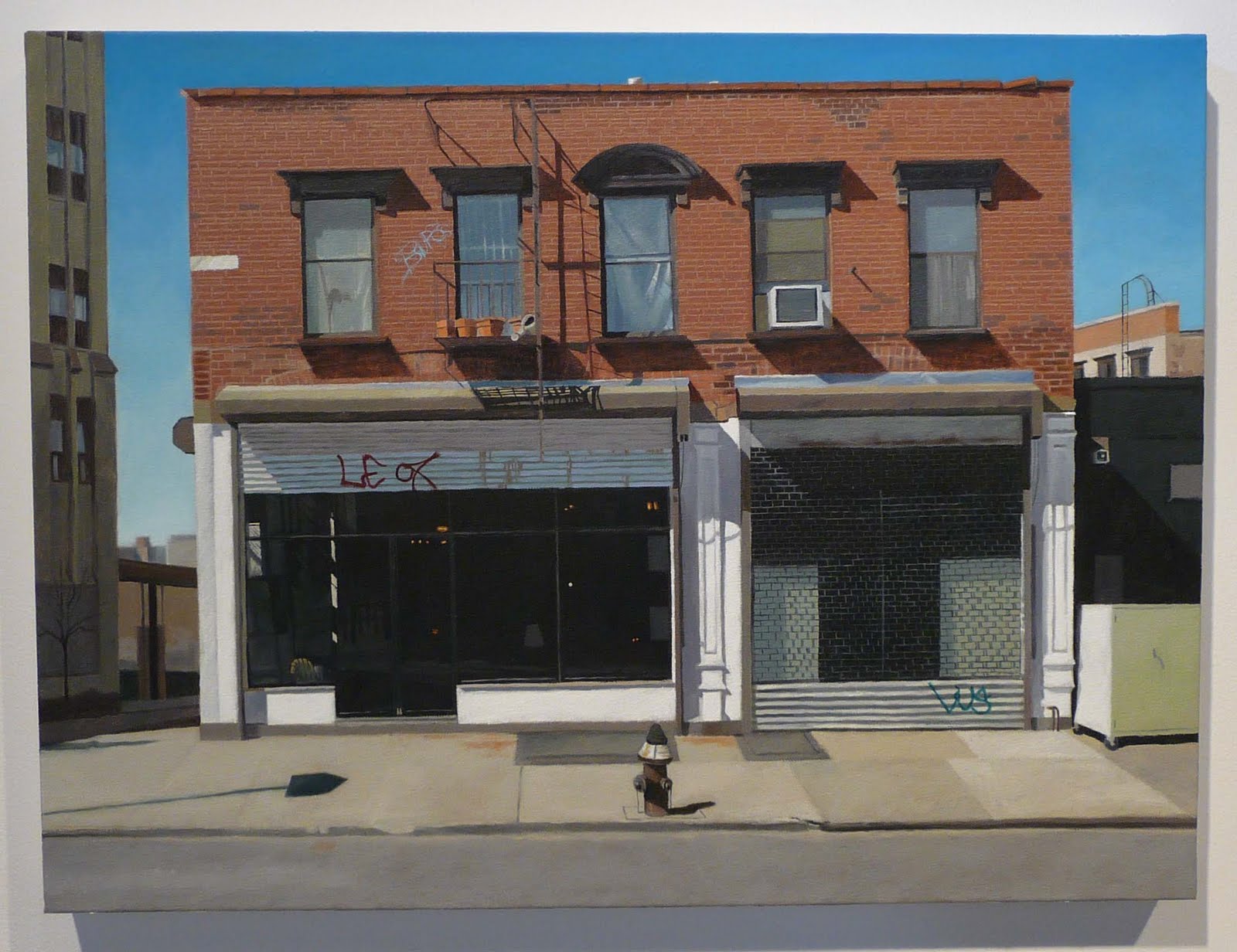
We can all admire fine craftsmanship – but that’s the first thing that comes to mind when standing before most of the paintings and sculptures in this survey of 12 contemporary artists at the McCormick Gallery. And shouldn’t painting demand attention to something more important? As Ben Tinsley does in “Furniture Store on Whyte”, a vignette of urban life that is “fixed in an artifice of eternity” (to quote Edward Snow regarding Vermeer). It’s half boarded up and definitely out of business, but unlike those melancholy Hopper scenes of New York, this abandoned little Chicago storefront sings with joy. Every detail is perfectly drawn and measured, especially the calligraphic graffiti that seems to have been applied by a wandering poet rather than gangbanger. Also exceptional in this exhibit are the two suburban cityscapes by John Santoro. No meticulously painted brickwork here – instead, these are meticulous paintings of paint. But they also present places the artist likes to live (his yard, front and back), rather unkempt, but no less timeless than the “10,000 years” mentioned in the titles he gave them. All the other abstract paintings in this exhibit just seem to be about paint.

Tuesday, April 13, 2010

Gladys Nilsson at U.I.M.A.


It’s not just that Gladys Nilsson is a female artist, but also that she presents a distinctly, if quirky, modern woman’s world. Which is presumably why the Illinois Committee of the National Museum of Women in the Arts has partnered with the Ukrainian Institute of Modern to give her this 40-year retrospective, pulling in paintings from area museums and collectors, as well as her own collection. And it’s hard to say just how her large, cartoonish watercolors have changed in all that time. There’s a few pieces from the sixties that share her husband’s (Jim Nutt) vision of an ominous, unhappy world. But mostly, she’s been consistently upbeat – with a colorful, cheerful, goofy clutter and a large, central female figure who seems triumphant to be just her own buoyant, dumpy, rubber-armed self. This is the happy, high energy world of children’s book illustration, except that the playful characters and primal colors of Nilsson’s paintings have escaped the confines of thin, simple narratives, and run riot from painting to painting, each busy corner demanding attention, and making an entire gallery of it as overwhelming as a trip to a child care center. But for relief, one can always wander over to the adjoining room through which rotates the museum’s permanent collection of Ukrainian as well as non-Ukrainian modern artists, as they echo the grim problems of the 20th Century, mostly caused by males.

Thursday, April 8, 2010

Matisse: Radical Invention 1913-1917 - at the Art Institute of Chicago

Like the Seurat exhibit at the Art Institute in 2004, this show is built around a single piece in the museum's collection, in this case, Matisse's "Bathers by a River" :


so, happily, it can continue to enhance the experience of that piece on permanent display, long after the rest of the show has closed. But while Seurat worked so creatively at discovering what he could fit in, 30 years later, Matisse seemed to be working very hard to find what he could take out. Recent x-radiographs have uncovered seven stages in that painting's eight years of development, and two computer stations allow viewers to scroll through diagrams of each one. Even better, since each stage can be seen completely, the exhibit has all 4 versions of his monumental sculptural relief, that begins with something like a woman's back, and ends with something more like an arrangement of cylinders. All of which may be fascinating , but does the piece get any more radical - or just more peaceful and decorative? And is this process of abstraction,"the modern method of construction", with all its layering and scraping, really the "radical innovation" which the title of this exhibit would suggest?

All such techniques can also be found in Cezanne's "Three Bathers" (also in this exhibit) , which was done 30 years earlier and later owned by Matisse himself.


Reducing the human figure to a kind of hieroglyph, Cezanne pioneered a kind of painting that was more like a personal calligraphy and less like a window on the world.

So Matisse’s innovation was just the development of his own personal logographics. His earlier work in this show, the “Blue Nude” of 1908, resembles the brash, angry, explosive modernism of Picasso and Stravinsky.


But then his painting became more subdued, as he cocooned himself into a quiet, prosperous domestic life, probably in response to the war that was decimating his countrymen.

Contemporary art theory requires that important artists be radically innovative, and if the results feel angry , dreary, or otherwise unpleasant, so much the better, as they trumpet the arrival of a new, modern world and challenge the self satisfied, mindless hedonism of the bourgeoisie.

It’s just that Matisse doesn’t always fit that mold, and hard as he may have worked to expunge anecdotal details, he still liked to paint flowers, goldfish, and pretty girls, and their charming ambience comes through, especially in his small, dry point or monotype figure drawings and various views of Tangier or his studio in Quai Saint-Michel.


Rather than exemplifying the radical, iconoclastic, transgressive innovation demanded of a modern European artist, Matisse’s work from 1913-1917 seems to better exemplify an aesthetic that is traditionally Asian.


Still Life with Goldfish, 1914


Some different responses are here:

Erik Wenzel
Janina Ciezadlo


Tuesday, January 5, 2010

Caravaggio: Supper at Emmaus


Caravaggio’s “Supper at Emmaus” and other “Caravaggesque” paintings, at the Art Institute of Chicago, through Jan. 31


1600 was a big year for Michelangelo Merisi da Caravaggio (1571-1610), and for the history of European painting, as that young man became famous for a dramatic realism that would develop a style for the counter-Reformation and begin to visualize the world of the street instead of the palace. One year later, he painted the “Supper at Emmaus” which is currently hanging in Gallery 211 at the Art Institute, surrounded by the works of those who followed him in the 17th. Century. And it has to be seen to be believed. Not so much for its fine detail, as for its size, and the way the figures project themselves into the viewer’s space, as it realizes that moment when God, through the Holy Ghost, dramatically entered human history. Which is to say, this is a very effective liturgical painting, and makes almost everything else in the room feel merely picturesque, especially the otherwise excellent painting by his rival, follower, chronicler, and bitter enemy, Giovanni Baglione (1566-1643).


Here's the Baglione
St. Francis


And here's a version
that Caravaggio did
about 5 years earlier


Why is it so effective? Certainly the drawing is important. Caravaggio drew directly on the canvas, unlike so many others who could only make great drawings on paper (Il Guercino, for example, whose “Entombment” hangs on the opposite wall).


Guercino


And here, in the actual painting, you can feel the careful modulation of tonal values that escaped so many of his followers (especially Bartolomeo Manfredi and Cecco del Caravaggio, whose works now hang on the same wall),


Manfredi


Ceccio


and escape all of the reproductions. (especially those transparencies that visited L.U.M.A. a few years ago) But overall, you just have to credit this tormented young man’s prophetic vision, which seems to have needed the power and beauty of divine grace much more than the rest of us.


(Note: here is the review that New City published.)