Thursday, April 28, 2022

Susanne Doremus at Zolla Lieberman


Would I have purchased a painting by Susanne Doremus back when she had her first solo exhibition in 1980? I’m not sure. That’s what Dennis Adrian did when he discovered her work in a back room at Artemisia Gallery.  Chicago’s leading art critic was probably responding to the very same sweeping spaciousness and high voltage marks  that are evident in her work forty years later. The airy space suggests a gentle, light hearted, well ordered life - evident much more in the actual work than in internet images. The circularity of the overall sweep suggests a recurring routine, like the seven days of a week or the twelve months of a year. The marks, however, often evoke persistent attacks of anxiety and even despair. And the artist appears to have been obsessed: working the piece until all possible ways to pull it all together have been exhausted. 

She’s definitely not among the Chicago Imagists whom Adrian was then making synonymous with art in Chicago. There isn’t the slightest hint of irony, adolescent rebellion or popular culture.  But there is the same self-centeredness.   She's not imagining places you'd like to go -- she's showing you where she's been.  When objects are identifiable, they might resemble a model she had seen posing at the art school where she taught or the housecat who slept on her window sill. 


Willem de Kooning, untitled, 1948/49, Art Institute of Chicago


She’s in the tradition of post-war Abstract Expression, as exemplified by the early De Kooning paintings at the Art Institute or Milton Resnick, with whom she had studied at the University of Wisconsin. But there’s nothing especially heroic about her work. Rather than drawing from personal life to make overwhelming expressions of power and despair, she uses the ABX lexicon to share the daily flow of a personal life that feels comfortable and ordinary, even if with persistent anxiety. Rather than human destiny being at stake, it’s more like whether she’ll be late for dinner if she gets stuck in traffic when picking up the kids. The virtue here is less the power of rhetoric - and more the truth of authenticity. These paintings feel like the daily journal of someone you might know. Or as Holland Cotter put it in 1995: her work is "like a tough semester's lecture notes from life".

Looking back to her early work, as found online, the swirly spaciousness has not changed. But the mark making has become so much more calligraphic. She can’t do all the things that can be accomplished by an ink loaded brush in the hands of an Asian master, but she can certainly make her lines dance, from the slow and sensual to the anxious and frenetic. And she takes bigger risks by sometimes introducing large, bold, and very awkward shapes - possibly executed with eyes closed.

In this, her 10th solo or duo exhibition at Zolla Lieberman since 1981, the work seems driven more by aesthetic effect than in work seen online from previous decades. Perhaps she is moving further away from feelings about her life, and closer to how paint feels as it touches the canvas. But we really need a career retrospective to make that kind of determination. Wouldn’t the Chicago Cultural Center be the perfect place for that to happen? With no sense of gender, ethnic , or racial identity other than straight, middle class, white suburban American female, she is further than ever from what’s trending in the art world. So perhaps that retrospective won’t be happening anytime soon.


******


In an adjoining room, the gallery presented a collection of local artists as chosen by Doremus herself. Many have been associated with the School of the Art Institute where she once chaired the Painting Department.  Mostly they make her work feel even more enjoyable by comparison.  Except for Jackie Kazarian ( shown above)

Wow!

Such a small painting to present so much fear and deliverance. 
We need to see more of her.
As Dennis Adrian discovered over forty years ago,
sometimes the real gems can be found in the back room.
 

*****

The paintings of Susanne Doremus are so distant from social/political commentary, I’m surprised that New City reviewed her show.  Over the past three decades, they never have.

But now they have published a review by Hadia Shaikh, an assistant director at the Block Museum.  And not surprisingly, the primary theme is that very distance.

She writes that:

Her work bears significant relation to the works of Julie Mehretru and Cy Twombly: multilayered, gestural, unbalanced and erratic.


Julie Mehretu, Conjured Parts (eye), Ferguson, 2016, 84"x96"

As Slate.com has noted, Mehretu "has created a new language for political art" - so I’m not sure she has that much in common with Doremus - at least regarding intentions.

Cy Twombly, untitled, 1964/1984


But the connection to Twombly is tighter than to the de Kooning piece I posted in my review.
The de Kooning  is about to explode  - the Twombly, like a Doremus painting, already has.


Wednesday, March 16, 2022

Joseph Lindon Smith at the Oriental Institute


Contemporary classical realist painters trace their lineage back to the Boston school of the early twentieth century. They combined the tight formal drawing of the French Academy with the looser brushwork and bolder colors of Impressionism. Leaders included Edmund Tarbell, William Paxton, Joseph Decamp, and Frank Benson. Benson (1862-1951) is the one best known in Chicago. Two of his paintings now hang in the Art Institute; one more is the highlight of the Vanderpoel Museum in Beverly.

Joseph Lindon Smith (1863-1950) was Benson’s friend and classmate both in Boston and Paris. Today he may best be known as the subject for a great portrait by Benson - but back in the day, he dominated his chosen subject matter: the representation of antiquities. And so it was that in 1935, the seventy two year old artist was invited by James Henry Breasted, the founder of the Oriental Institute at the University of Chicago, to accompany an archeological expedition to Persepolis.

Skilled draftsmen are often needed in such projects to document shapes too faint to be identifiable by photograph. But Smith’s large paintings appear to have served a more aesthetic purpose. As gallery signage confirms, “He conformed solely to his own distinctive style”. Excavation may be drudgery, but once uncovered, the monuments of past empires can be appreciated as the glorious foundation of contemporary civilization. Or, at least, that’s how those at the top, like the “Boston Brahmins”, might like to have seen it. Isabella Stewart Gardner, founder of her eponymous art museum in Boston, was one of Smith’s patrons. 


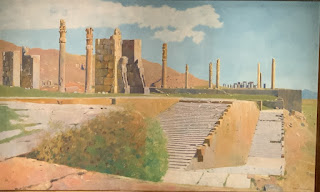
Of Smith’s six Persepolis pieces, three are landscape views of the entire site with whatever architectural elements still remained. Depictions of ancient ruins often appeared in the annual Salons of the French Royal Academy. Populated with tourists or travelers, they invoke a romantic sentiment of transitory glory. But Smith presents the broken walls and surviving columns just as an Impressionist might paint the cliffs and saguaro cactus of the Sonoran desert. He’s mostly concerned with light and space. These are pleasant views, though more like prose than poetry. 
 
Smith’s three depictions of the 4th century BC sculptural reliefs are also pleasant. His contour lines feel as chiseled as limestone. The spaces within them have been rendered with chromatic blended areas of thin paint, much like a watercolor. Missing or damaged details have been repaired. The results would fit the decor of an elegant, modern living space. But that is far from the powerful, almost unnerving effect of the original stone carvings, one of which, happily, has recently arrived in Chicago after an eighty year loan to the Museum of Fine Arts, Boston. 


If you walk around to the other end of the museum, you will find it. One of the most vibrant pieces of ancient sculpture in this or any museum. It is not the same piece that Smith painted, but it is indeed, very, very close. Evidently, this repetitive motif of mortal combat between bull and lion was designed to convince subservient rulers of the majesty, and potential violence, of the Persian king of kings. Probably Smith’s patrons wanted something more genteel. Their old school wealth was threatened by the explosive growth of American capitalism just as their tame academic art was being overwhelmed by brash Modernists like Picasso. Both the refinement of Smith and the ferocity of the ancient sculpture have become anachronisms in the art world a hundred years later. But both still can be appreciated.


Monday, March 7, 2022

Bob Thompson - at the Smart Museum


The Koffler collection of Chicago art introduced me to Bob Thompson (1937-1966) almost ten years ago. It had just been donated to the Depaul Art Museum which immediately put some selected pieces on display. Thompson never lived anywhere nearby , so why was he included among all the distinguished Chicago artists? Perhaps the Kofflers wished he really had worked here - and so do I. He did for Old Master European painting what jazz was doing for American musical theater: transforming a strong narrative tradition into a platform for personal virtuosity and self expression. What a surprise in the context of postwar American art! And what a challenge to carry it off with elegance and style - while still preserving just enough of the narrative to keep it comprehensible and compelling.

The Thompson story is both magic and tragic. His career began at the University of Louisville where Charles Crodel, a German expressionist painter and designer of stained glass windows, was a visiting professor. He was probably responsible for linkingThompson to the European tradition as well as the simplified figurative style he would adopt. Soon after graduation, Thompson was having solo shows in New York City, hanging out with the poet, LeRoi Jones (Amiri Baraka) , and hearing, if not jamming with, some of the most progressive jazz artists of the day. (Thompson played drums). The exhibit includes a portrait of the Jones family, as well as “The Garden of Music”, a wall size landscape with cameo portraits of his musical friends or heroes: John Coltrane, Ornette Coleman, Don Cherry, Sonny Rollins and Charlie Haden among others. His paintings were selling, he was making hundreds of them, and he was moving through Europe, visiting art museums and riffing on what he had seen. Then suddenly it all stopped. He was dead at the age of 28.

The portraits mentioned above are interesting mostly for their subject matter. Thompson’s figure drawing was more about pictorial space than figurative expression. The personal nature of the portraits interrupted his sense of space, so the pieces are left feeling awkward and clumsy. Gallery signage suggests that the portrait of the Jones family is unfinished. Occasionally, that clumsiness is felt elsewhere in the show. Thompson may have thought of his paintings as improvisations. Some are hits - some are misses - it doesn’t matter - just move on to the next song on the playlist.


His figures are silhouettes filled in with solid color, much like Matisse. Their contour lines usually lack that early Modernist’s athletic energy and inner life - but the deep surrounding space is so much more ebullient and disruptive. There’s the joy of astonishing disharmony - much like the music of Thelonious Monk. But is there any narrative content worth noting? Gallery signage tells that ”he distorts those received forms in ways that both compound their ambiguity and reveal their relevance to contemporary concerns in the United States from civil rights to freedom of expression to sexual liberation”. But that sounds way too political for the light hearted playfulness that is so upfront. If you ask “what is going on here?” , you will invoke the thrill of absurdity rather than the recognition of some profound theme. In the paintings that riff on Goya’s “Caprichos”, contempt and scorn is replaced by goofiness. The oversized birds and looming, silly monsters recall the world of children’s puppet theater - though the recurring demarcation of the pubic area, suggest work made by, rather than for, children. There is little especially profound here other than the buoyancy of the artist’s spirit. That’s the most important quality that Thomson’s work shares with the Old masters that he drew from. It might also be seen as an outsider's view of  the Euro-Centric imagination - but it remains Euro-Centric, and patriarchal, none the less.


*****************


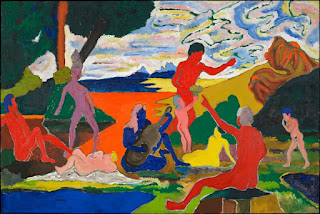
Homage to Nina Simone


A magnificent, psychedelic mess, the swirling visual incongruities here keep the viewer continually off balance.

Nina Simone is the naked, pelvic-thrusting  lady standing to the left.  She is colored purple, not black, so  we know that racial politics are not an issue.  This is not Kerry James Marshall.


Black Monster


In an online video about this painting, Nicole Bond, Smart Museum Lead Educator, points out that scholars have expressed "opinions which equate the large pointed toothed beast to one of the most feared yet envied human attributes:  black male sexuality"  And it certainly appears that this amorous monster is hunting white girls, not black ones.


Here's another image of a dark creature hunting a naked white girl - this one  being used to promote one of his exhibitions.

It's not a theme that dominates Thompson's work - but he does occasionally visit  American attitudes towards inter-racial sex.  Like LeRoi Jones, Thompson married a white woman.


************

Dmitry Samarov has also reviewed the show  in the Chicago Reader.

 His piece is more of an ecomium - but as an effective figurative painter himself, everything he says about the figure painting of others is interesting. 

 Diane Thodos has some interesting things to say about the blank faces, paradise, and the expressionist painter, Jan Muller.

Wednesday, December 15, 2021

David Antonio Cruz at Monique Meloche

 Can You Stay With Me Tonight


Something momentous happened to humanity a year after David Antonio Cruz’s first Chicago show in 2019. Back then, as gallery verbiage put it : “Cruz’s deeply empathetic gaze enlightens the viewer to those overlooked but urgently salient experiences” of “his black and brown subjects” who have been the “victims” of “extreme injustice”. It’s a message still trending throughout the art world.

It’s not that we no longer need to be enlightened about injustice, but Covid 19 made personal  isolation a primary issue for just about everyone regardless of race, gender, class, or ethnic identity - and Cruz (b. 1974) confronts that universal loneliness with an edgy anxiety and shimmering beauty as old school as the sixth century mosaics at Ravenna. All of his figures are dressed just as smartly. The jazzy, colorful patterns on their shirts are sharp or blurry just where they need to be. If Cruz owned a boutique, I would shop there. But just like the bejeweled Byzantine royal family, not one of the faces is smiling. All of their somber eyes stare right back at the viewer -- as if they were scrutinizing you, rather than the other way around. None of the men depicted are young or especially attractive, but all of them feel quite real and present. This is not the queer world of awkward arousal and confusion. It’s more like David Hockney’s precise world of loneliness, desire, and self interest. As the title of the exhibition puts it: “I cut from the middle to get a better slice”


The spherical space helmets worn by some of the figures in his last show are now gone. No one feels that alienated any more. Some of the figures do, however, wear a kind of blue-green vinyl glove - as if they were still leery of skin-to-skin contact. More importantly, the backgrounds are now tinted - while the old monochrome backgrounds have migrated over to their own panels. They present a ghostly alternative reality, haunted by spectral faces and writhing limbs. A bright, bold and colorful world for the living - a dark, retreating, colorless world for the dead.


Cruz has developed his own, uplifting style of figure painting. Pictorial space is flat. The figures don’t just sit on the surface, they appear to emanate from the wall. Contours are strongly emphasized with contrasting tones that may defy reality. Between the curvaceous edges, the areas of pattern or solid color glow, as if lit from behind rather than from ambient light. It’s similar to the translucent sheets of glass locked within the sinuous lines of lead in the great cathedral windows of the Middle Ages. In both, the effect is transcendent. Every area of body, clothing, furniture, or background seems to erupt off the surface , demanding attention. The viewer must respond. Spirit has entered the room.


The masterpiece here is “Can you stay with me tonight ?” (the full text reads: “canyoustaywithmetonight_causeyouarehere,youarehere,andweareherewithyou”), It’s a monumental 6X8 diptych showing nine men ensconced on a giant sofa, much like hors d'oeuvres on a serving tray: so fresh,  so yearning, so sincere. None of them interacting or touching - all looking out at the viewer and asking "Will you pick me?". All of them are well dressed and the ambiance is tropically festive with an “aspirational aesthetic of luxury and fashion”, not unlike the 18th Century aristocrats painted by Hyacinthe Rigaud.  You want them all to find the love they need - just as you want the saints in a religious diptych to intercede with the divine. Sustaining a community of faith has not been the intention of mainstream Western painting since the Baroque. David Antonio Cruz has just revived it.

*********************


onedayi’llturnthecornerandi’llbereadyforit, 2019 

(shown in 2019)


Theodora mosaic, San Vitale, Ravenna,  A.D. 547


Hyacinths Rigaud, Gaspard de Gueidan, 1738

 BTW - Gaspard was not born to the high aristocracy, but through marriage, investment, and strategy he almost achieved it.


Sunday, November 28, 2021

Peter Uka at Mariane Ibrahim


  Blue Jacket, 2021 (75" X 57")


Kerry James Marshall. That was my first thought on entering the gallery. The heroic presentation of the every day life of Black people with the bold design and simplification of poster art. The proud, strong, and  stately figures with faces too dark to show much expression. But how could a Chicago painter affect Peter Uka ( b. 1975) a Nigerian living in Germany? Is the world really that small? Or does a Chicago painter, who is not Imagist, actually have an international following. As Uka talks about his early career:

 “I just needed a sense of direction, so to say, in the sense of some sort of encouragement from somewhere. That came in the likes of Kerry James Marshall, as crazy as it might sound. There was an exhibition of his a couple of years ago, it’s been quite a while, in the Ludwig Museum here. And I saw it, and was like, whoa!”


“Whoa” indeed. That was also my reaction on first seeing Marshall’s work at the Art Institute back in the nineties. Perhaps that work is too powerful for local Chicago artists to follow in his footsteps. They would all come up short. But Uka has his own vision, power, and cultural identity. Despite their centuries long history of oppression, contemporary African American artists are notably free, inventive, challenging, and surprising in their expressions. Uka presents a world that is as proper and repressed as a church social. One piece, “Beach Life”, feels like it could be the backdrop in a taxidermy display case at the Field Museum. Another piece, “Sideburn Brothers”, looks like a casual Polaroid snapshot of friends from the neighborhood.

Sadness and emptiness are conflated with neatness, cleanliness, and perfection. None of the clothing appears worn - or expensive. It’s as if it had just arrived from a downscale mail order catalog. And none of the characters are doing or feeling anything. No happiness, no anger, no despair, no interpersonal tension. There’s a lot of blank stares. The narratives are boring - but the paintings are not. Uka is a lively and creative designer - with a special feel for how areas of strong color can impact a  tight pictorial space. This is painting for those who enjoy sharpness and precision.

This selection of recent paintings, titled “Longing”, may not be representative of his best work. More  stunning pieces can be found on the internet. But even those pieces also present people doing nothing. Unlike Marshall, he does not speak for a people in history - he speaks for his own memories. How the world once appeared to a curious child.

The one piece that has some narrative life is “Blue Jacket”. The brilliant blue jacket of a thin young man has become tangled in a small tree just outside the grated windows of someone’s home. He has turned his head to gaze furtively at whatever is behind him. I doubt that he lives there.

Perhaps Marshall’s narratives are more exciting because he has engaged with his country’s tumultuous changes. Many Nigerians may feel stuck - or at least Peter Uka may have felt that way when he decided to live elsewhere.  Hopefully he won't always have to look backward.


Beach Life (71" X 98")


Sideburn Brothers (86" X 75")


**********************


The New City review  , "Unapologetically Authentic",  makes me wonder when the figurative art of black artists will no longer be seen through the lens of racial politics. When will we allow black artists to present black people in more personal and politically ambivalent situations?

Peter Uka does indeed credit Kerry Marshall as a powerful influence, but Marshall paints for a people. Uka draws from personal memories to paint about himself.

Thursday, October 28, 2021

Celeste Rapone at Corbett Vs Dempsey


Controlled Burn


Fifty-five years after the first Hairy Who exhibition, Imagism is still alive and well in Chicago - mostly thanks to talented young artists like Celeste Rapone ( b. 1985) who continue to apply strong design and evident precision to cartoonish figuration with a fresh, youthful attitude. Maybe it’s just the most accessible way for artists in their early career to assert themselves into a geriatric world that is as powerful and efficient as it is dysfunctional and corrupt.

Rapone’s gentle floating bodies recall the tubular figures of Gladys Nilsson. Throughout, there is the evident craft and charm of Barbara Rossi, though Rapone’s paintings, like a mural, command a room instead of just decorate a wall. There’s nothing caustic, threatening, or ironic here as one might find with the male Imagists. There’s just gentle, zany humor - with the urban sophistication that one associates with the life-style magazines that target young women. All of Rapone’s solitary figures are young women  (self portraits ?) and they have apparently just furnished their first apartment on the north side after growing up in DuPage County.

The apparent narrative is as shallow as check-out counter journalism, but as the artist has stated, these pieces began as non-figurative designs - and that is how they really stand out. They’re as bold, upbeat, eye catching, and inventive as the modernist posters commissioned for the London Underground (remember that cheerful show at the Art Institute in 2019?). Like those posters, these paintings promote life in the big city. Unlike those posters, however, these pieces have the exquisite close-up aesthetic that can distinguish paintings from prints. Every square inch is energized and alive with precision.

And perhaps the narrative is not all that upbeat after all. Rapone’s angular designs reach out to demand attention - but they also strongly pull inward - sucking the viewer into a sense of claustrophobia. Considering the year in which these pieces were made, we might call it cabin fever during the great Covid epidemic shutdown. The figures appear to trapped by the edges of the painting. They’re all bored - even when the boyfriend stops by. After sex - then what? Daydream about sailing an imaginary boat on an imaginary stream? 


  Spring Couple


Saturday, October 23, 2021

Carmen Chami at National Museum of Mexican Art


If “Adlateres and the Unexpected Visit’’ ( The title piece of this exhibition - shown above ) is even slightly autobiographical, Carmen Chami is not especially happy about leaving Mexico. Immersed in iconic Mexican art, from the Baroque spirituality of Cristóbal de Villalpando (17th Century) to the surreal self dramatization of Frida Kahlo, she has neither the prankish humor nor the righteous social justice favored in Chicago.. And her work is visceral - the very opposite of the conceptual art still trending in university art departments. She paints, and presumably lives, entirely in a world of the spirit - a dark world illuminated by revelation rather than the sun. 


Zapata's Widows, as an Excuse


If her “intention is to make art that is completely universal" (as she asserts), then she is a spectacular failure - at least so far as this viewer is concerned. I have no idea, for example, what “Zapata’s widows as an excuse” is about - and there is no gallery text to explain it. What are those two, spread-eagled, interlocking young women doing? Is there some obscure legend about the wives of Emilio and his brother ? What about their behavior might serve as an excuse for anything? It hardly feels like a sexual interaction - It’s more like they are floating around in a dream - possibly their own. This painting is far more personal than universal.


Sadness, confusion, frustration, and anger seem to permeate the narratives in the show - but the vehicles that carry them are extraordinarily well made. Like the old masters, Chami composes figurative gesture simultaneous with graphic energy. So even when the subject is incomprehensible, the painting still feels so profound that the viewer is compelled to figure it out.


The Bad News


Her portraits, however,require no explanation, and there are several good ones - especially the self portrait titled “The Bad News”. Wow! What a painting! Possibly, for this artist, people do not exist except within intense moments of living. It’s the very opposite of treating the human body as still-life or clothes horse. Like Frida, she sees herself as suffering - inviting the viewer to share her most intimate moments. In her other great self portrait, the artist imagines herself as “Judith”, the Biblical heroine, who decapitates the enemy general who has taken her to bed. Grabbing her by the ankles, he is just about to drive home his point when - ooops - she cuts off his head with a handy sword. Our attention is drawn to the wild, cross eyed look that flashes across Chami’s (Judith’s) face. There are several great 17th century depictions of this gruesome scene - and Chami’s could hang right beside them.


Judith


As with Artemesia Gentileschi (a victim of rape) the exemplary story of Judith has served this artist well as a conflation of the deeply personal with the stridently political. Most of the other pieces, however, just have me admiring the artist’s virtuosity. “Incredulidad” (disbelief), presents a blind-folded woman touching the sternum of a reclining half naked man. It echoes Doubting Thomas when he touched the wounded chest of the resurrected Christ. The woman resembles the artist herself just as the man resembles the Holofernes mentioned above. But does this puzzling and apparently personal story really deserve such a luminous and complex pictorial space as well as the reference to sacred narrative? Where Frida’s self obsessions feel quirky - Chami’s feel ponderous.


Disbelief


The visual language of the 17th Century masters implies a universe of grand design and profound purpose. As applied in many of these paintings, that purpose is apparently to make humans miserable and there is certainly plenty of evidence from around the world to support such a belief.
 
 But you would have to be more depressed and fatalistic than I to accept it.


**************
 
 
Postscript:
 
My friend Misha Livshlultz has pointed out that there's no blood in Chami's version of Judith and Holofernes.  Not on the sword, not dripping from the head, not staining the sheets.  

One might conclude that the relationship here depicted is no more violent and abusive than the heterosexual act itself - which for some women might well be violent enough.