Monday, March 7, 2022

Bob Thompson - at the Smart Museum


The Koffler collection of Chicago art introduced me to Bob Thompson (1937-1966) almost ten years ago. It had just been donated to the Depaul Art Museum which immediately put some selected pieces on display. Thompson never lived anywhere nearby , so why was he included among all the distinguished Chicago artists? Perhaps the Kofflers wished he really had worked here - and so do I. He did for Old Master European painting what jazz was doing for American musical theater: transforming a strong narrative tradition into a platform for personal virtuosity and self expression. What a surprise in the context of postwar American art! And what a challenge to carry it off with elegance and style - while still preserving just enough of the narrative to keep it comprehensible and compelling.

The Thompson story is both magic and tragic. His career began at the University of Louisville where Charles Crodel, a German expressionist painter and designer of stained glass windows, was a visiting professor. He was probably responsible for linkingThompson to the European tradition as well as the simplified figurative style he would adopt. Soon after graduation, Thompson was having solo shows in New York City, hanging out with the poet, LeRoi Jones (Amiri Baraka) , and hearing, if not jamming with, some of the most progressive jazz artists of the day. (Thompson played drums). The exhibit includes a portrait of the Jones family, as well as “The Garden of Music”, a wall size landscape with cameo portraits of his musical friends or heroes: John Coltrane, Ornette Coleman, Don Cherry, Sonny Rollins and Charlie Haden among others. His paintings were selling, he was making hundreds of them, and he was moving through Europe, visiting art museums and riffing on what he had seen. Then suddenly it all stopped. He was dead at the age of 28.

The portraits mentioned above are interesting mostly for their subject matter. Thompson’s figure drawing was more about pictorial space than figurative expression. The personal nature of the portraits interrupted his sense of space, so the pieces are left feeling awkward and clumsy. Gallery signage suggests that the portrait of the Jones family is unfinished. Occasionally, that clumsiness is felt elsewhere in the show. Thompson may have thought of his paintings as improvisations. Some are hits - some are misses - it doesn’t matter - just move on to the next song on the playlist.


His figures are silhouettes filled in with solid color, much like Matisse. Their contour lines usually lack that early Modernist’s athletic energy and inner life - but the deep surrounding space is so much more ebullient and disruptive. There’s the joy of astonishing disharmony - much like the music of Thelonious Monk. But is there any narrative content worth noting? Gallery signage tells that ”he distorts those received forms in ways that both compound their ambiguity and reveal their relevance to contemporary concerns in the United States from civil rights to freedom of expression to sexual liberation”. But that sounds way too political for the light hearted playfulness that is so upfront. If you ask “what is going on here?” , you will invoke the thrill of absurdity rather than the recognition of some profound theme. In the paintings that riff on Goya’s “Caprichos”, contempt and scorn is replaced by goofiness. The oversized birds and looming, silly monsters recall the world of children’s puppet theater - though the recurring demarcation of the pubic area, suggest work made by, rather than for, children. There is little especially profound here other than the buoyancy of the artist’s spirit. That’s the most important quality that Thomson’s work shares with the Old masters that he drew from. It might also be seen as an outsider's view of  the Euro-Centric imagination - but it remains Euro-Centric, and patriarchal, none the less.


*****************
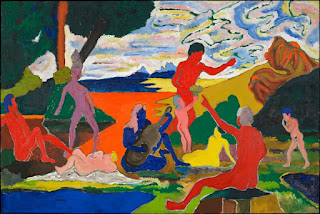

Homage to Nina Simone


A magnificent, psychedelic mess, the swirling visual incongruities here keep the viewer continually off balance.

Nina Simone is the naked, pelvic-thrusting  lady standing to the left.  She is colored purple, not black, so  we know that racial politics are not an issue.  This is not Kerry James Marshall.


Black Monster


In an online video about this painting, Nicole Bond, Smart Museum Lead Educator, points out that scholars have expressed "opinions which equate the large pointed toothed beast to one of the most feared yet envied human attributes:  black male sexuality"  And it certainly appears that this amorous monster is hunting white girls, not black ones.


Here's another image of a dark creature hunting a naked white girl - this one  being used to promote one of his exhibitions.

It's not a theme that dominates Thompson's work - but he does occasionally visit  American attitudes towards inter-racial sex.  Like LeRoi Jones, Thompson married a white woman.


************

Dmitry Samarov has also reviewed the show  in the Chicago Reader.

 His piece is more of an ecomium - but as an effective figurative painter himself, everything he says about the figure painting of others is interesting. 

 Diane Thodos has some interesting things to say about the blank faces, paradise, and the expressionist painter, Jan Muller.

Wednesday, December 15, 2021

David Antonio Cruz at Monique Meloche

 Can You Stay With Me Tonight


Something momentous happened to humanity a year after David Antonio Cruz’s first Chicago show in 2019. Back then, as gallery verbiage put it : “Cruz’s deeply empathetic gaze enlightens the viewer to those overlooked but urgently salient experiences” of “his black and brown subjects” who have been the “victims” of “extreme injustice”. It’s a message still trending throughout the art world.

It’s not that we no longer need to be enlightened about injustice, but Covid 19 made personal  isolation a primary issue for just about everyone regardless of race, gender, class, or ethnic identity - and Cruz (b. 1974) confronts that universal loneliness with an edgy anxiety and shimmering beauty as old school as the sixth century mosaics at Ravenna. All of his figures are dressed just as smartly. The jazzy, colorful patterns on their shirts are sharp or blurry just where they need to be. If Cruz owned a boutique, I would shop there. But just like the bejeweled Byzantine royal family, not one of the faces is smiling. All of their somber eyes stare right back at the viewer -- as if they were scrutinizing you, rather than the other way around. None of the men depicted are young or especially attractive, but all of them feel quite real and present. This is not the queer world of awkward arousal and confusion. It’s more like David Hockney’s precise world of loneliness, desire, and self interest. As the title of the exhibition puts it: “I cut from the middle to get a better slice”


The spherical space helmets worn by some of the figures in his last show are now gone. No one feels that alienated any more. Some of the figures do, however, wear a kind of blue-green vinyl glove - as if they were still leery of skin-to-skin contact. More importantly, the backgrounds are now tinted - while the old monochrome backgrounds have migrated over to their own panels. They present a ghostly alternative reality, haunted by spectral faces and writhing limbs. A bright, bold and colorful world for the living - a dark, retreating, colorless world for the dead.


Cruz has developed his own, uplifting style of figure painting. Pictorial space is flat. The figures don’t just sit on the surface, they appear to emanate from the wall. Contours are strongly emphasized with contrasting tones that may defy reality. Between the curvaceous edges, the areas of pattern or solid color glow, as if lit from behind rather than from ambient light. It’s similar to the translucent sheets of glass locked within the sinuous lines of lead in the great cathedral windows of the Middle Ages. In both, the effect is transcendent. Every area of body, clothing, furniture, or background seems to erupt off the surface , demanding attention. The viewer must respond. Spirit has entered the room.


The masterpiece here is “Can you stay with me tonight ?” (the full text reads: “canyoustaywithmetonight_causeyouarehere,youarehere,andweareherewithyou”), It’s a monumental 6X8 diptych showing nine men ensconced on a giant sofa, much like hors d'oeuvres on a serving tray: so fresh,  so yearning, so sincere. None of them interacting or touching - all looking out at the viewer and asking "Will you pick me?". All of them are well dressed and the ambiance is tropically festive with an “aspirational aesthetic of luxury and fashion”, not unlike the 18th Century aristocrats painted by Hyacinthe Rigaud.  You want them all to find the love they need - just as you want the saints in a religious diptych to intercede with the divine. Sustaining a community of faith has not been the intention of mainstream Western painting since the Baroque. David Antonio Cruz has just revived it.

*********************


onedayi’llturnthecornerandi’llbereadyforit, 2019 

(shown in 2019)


Theodora mosaic, San Vitale, Ravenna,  A.D. 547


Hyacinths Rigaud, Gaspard de Gueidan, 1738

 BTW - Gaspard was not born to the high aristocracy, but through marriage, investment, and strategy he almost achieved it.


Sunday, November 28, 2021

Peter Uka at Mariane Ibrahim


  Blue Jacket, 2021 (75" X 57")


Kerry James Marshall. That was my first thought on entering the gallery. The heroic presentation of the every day life of Black people with the bold design and simplification of poster art. The proud, strong, and  stately figures with faces too dark to show much expression. But how could a Chicago painter affect Peter Uka ( b. 1975) a Nigerian living in Germany? Is the world really that small? Or does a Chicago painter, who is not Imagist, actually have an international following. As Uka talks about his early career:

 “I just needed a sense of direction, so to say, in the sense of some sort of encouragement from somewhere. That came in the likes of Kerry James Marshall, as crazy as it might sound. There was an exhibition of his a couple of years ago, it’s been quite a while, in the Ludwig Museum here. And I saw it, and was like, whoa!”


“Whoa” indeed. That was also my reaction on first seeing Marshall’s work at the Art Institute back in the nineties. Perhaps that work is too powerful for local Chicago artists to follow in his footsteps. They would all come up short. But Uka has his own vision, power, and cultural identity. Despite their centuries long history of oppression, contemporary African American artists are notably free, inventive, challenging, and surprising in their expressions. Uka presents a world that is as proper and repressed as a church social. One piece, “Beach Life”, feels like it could be the backdrop in a taxidermy display case at the Field Museum. Another piece, “Sideburn Brothers”, looks like a casual Polaroid snapshot of friends from the neighborhood.

Sadness and emptiness are conflated with neatness, cleanliness, and perfection. None of the clothing appears worn - or expensive. It’s as if it had just arrived from a downscale mail order catalog. And none of the characters are doing or feeling anything. No happiness, no anger, no despair, no interpersonal tension. There’s a lot of blank stares. The narratives are boring - but the paintings are not. Uka is a lively and creative designer - with a special feel for how areas of strong color can impact a  tight pictorial space. This is painting for those who enjoy sharpness and precision.

This selection of recent paintings, titled “Longing”, may not be representative of his best work. More  stunning pieces can be found on the internet. But even those pieces also present people doing nothing. Unlike Marshall, he does not speak for a people in history - he speaks for his own memories. How the world once appeared to a curious child.

The one piece that has some narrative life is “Blue Jacket”. The brilliant blue jacket of a thin young man has become tangled in a small tree just outside the grated windows of someone’s home. He has turned his head to gaze furtively at whatever is behind him. I doubt that he lives there.

Perhaps Marshall’s narratives are more exciting because he has engaged with his country’s tumultuous changes. Many Nigerians may feel stuck - or at least Peter Uka may have felt that way when he decided to live elsewhere.  Hopefully he won't always have to look backward.


Beach Life (71" X 98")


Sideburn Brothers (86" X 75")


**********************


The New City review  , "Unapologetically Authentic",  makes me wonder when the figurative art of black artists will no longer be seen through the lens of racial politics. When will we allow black artists to present black people in more personal and politically ambivalent situations?

Peter Uka does indeed credit Kerry Marshall as a powerful influence, but Marshall paints for a people. Uka draws from personal memories to paint about himself.

Thursday, October 28, 2021

Celeste Rapone at Corbett Vs Dempsey


Controlled Burn


Fifty-five years after the first Hairy Who exhibition, Imagism is still alive and well in Chicago - mostly thanks to talented young artists like Celeste Rapone ( b. 1985) who continue to apply strong design and evident precision to cartoonish figuration with a fresh, youthful attitude. Maybe it’s just the most accessible way for artists in their early career to assert themselves into a geriatric world that is as powerful and efficient as it is dysfunctional and corrupt.

Rapone’s gentle floating bodies recall the tubular figures of Gladys Nilsson. Throughout, there is the evident craft and charm of Barbara Rossi, though Rapone’s paintings, like a mural, command a room instead of just decorate a wall. There’s nothing caustic, threatening, or ironic here as one might find with the male Imagists. There’s just gentle, zany humor - with the urban sophistication that one associates with the life-style magazines that target young women. All of Rapone’s solitary figures are young women  (self portraits ?) and they have apparently just furnished their first apartment on the north side after growing up in DuPage County.

The apparent narrative is as shallow as check-out counter journalism, but as the artist has stated, these pieces began as non-figurative designs - and that is how they really stand out. They’re as bold, upbeat, eye catching, and inventive as the modernist posters commissioned for the London Underground (remember that cheerful show at the Art Institute in 2019?). Like those posters, these paintings promote life in the big city. Unlike those posters, however, these pieces have the exquisite close-up aesthetic that can distinguish paintings from prints. Every square inch is energized and alive with precision.

And perhaps the narrative is not all that upbeat after all. Rapone’s angular designs reach out to demand attention - but they also strongly pull inward - sucking the viewer into a sense of claustrophobia. Considering the year in which these pieces were made, we might call it cabin fever during the great Covid epidemic shutdown. The figures appear to trapped by the edges of the painting. They’re all bored - even when the boyfriend stops by. After sex - then what? Daydream about sailing an imaginary boat on an imaginary stream? 


  Spring Couple


Saturday, October 23, 2021

Carmen Chami at National Museum of Mexican Art


If “Adlateres and the Unexpected Visit’’ ( The title piece of this exhibition - shown above ) is even slightly autobiographical, Carmen Chami is not especially happy about leaving Mexico. Immersed in iconic Mexican art, from the Baroque spirituality of Cristóbal de Villalpando (17th Century) to the surreal self dramatization of Frida Kahlo, she has neither the prankish humor nor the righteous social justice favored in Chicago.. And her work is visceral - the very opposite of the conceptual art still trending in university art departments. She paints, and presumably lives, entirely in a world of the spirit - a dark world illuminated by revelation rather than the sun. 


Zapata's Widows, as an Excuse


If her “intention is to make art that is completely universal" (as she asserts), then she is a spectacular failure - at least so far as this viewer is concerned. I have no idea, for example, what “Zapata’s widows as an excuse” is about - and there is no gallery text to explain it. What are those two, spread-eagled, interlocking young women doing? Is there some obscure legend about the wives of Emilio and his brother ? What about their behavior might serve as an excuse for anything? It hardly feels like a sexual interaction - It’s more like they are floating around in a dream - possibly their own. This painting is far more personal than universal.


Sadness, confusion, frustration, and anger seem to permeate the narratives in the show - but the vehicles that carry them are extraordinarily well made. Like the old masters, Chami composes figurative gesture simultaneous with graphic energy. So even when the subject is incomprehensible, the painting still feels so profound that the viewer is compelled to figure it out.


The Bad News


Her portraits, however,require no explanation, and there are several good ones - especially the self portrait titled “The Bad News”. Wow! What a painting! Possibly, for this artist, people do not exist except within intense moments of living. It’s the very opposite of treating the human body as still-life or clothes horse. Like Frida, she sees herself as suffering - inviting the viewer to share her most intimate moments. In her other great self portrait, the artist imagines herself as “Judith”, the Biblical heroine, who decapitates the enemy general who has taken her to bed. Grabbing her by the ankles, he is just about to drive home his point when - ooops - she cuts off his head with a handy sword. Our attention is drawn to the wild, cross eyed look that flashes across Chami’s (Judith’s) face. There are several great 17th century depictions of this gruesome scene - and Chami’s could hang right beside them.


Judith


As with Artemesia Gentileschi (a victim of rape) the exemplary story of Judith has served this artist well as a conflation of the deeply personal with the stridently political. Most of the other pieces, however, just have me admiring the artist’s virtuosity. “Incredulidad” (disbelief), presents a blind-folded woman touching the sternum of a reclining half naked man. It echoes Doubting Thomas when he touched the wounded chest of the resurrected Christ. The woman resembles the artist herself just as the man resembles the Holofernes mentioned above. But does this puzzling and apparently personal story really deserve such a luminous and complex pictorial space as well as the reference to sacred narrative? Where Frida’s self obsessions feel quirky - Chami’s feel ponderous.


Disbelief


The visual language of the 17th Century masters implies a universe of grand design and profound purpose. As applied in many of these paintings, that purpose is apparently to make humans miserable and there is certainly plenty of evidence from around the world to support such a belief.
 
 But you would have to be more depressed and fatalistic than I to accept it.


**************
 
 
Postscript:
 
My friend Misha Livshlultz has pointed out that there's no blood in Chami's version of Judith and Holofernes.  Not on the sword, not dripping from the head, not staining the sheets.  

One might conclude that the relationship here depicted is no more violent and abusive than the heterosexual act itself - which for some women might well be violent enough.

Tuesday, October 19, 2021

Pooja Pittie at Thomas Mccormick Gallery


Wanted to be elsewhere, but saw no way to get there


 Pooja Pittie is an outsider artist - not because she lives on the margins of society - far from it - but because her art is so much closer to herself than to the Artworld. Being self taught, her work appears untethered to any theory of art other than her own. She does not engage art history, she engages her viewers whom she treats like guests to her psychic home. As hostess, she wants us to enjoy ourselves. But she also wants us to experience the full force and drama of her life - a life that is slowly but surely ebbing away with a degenerative disorder.

These two intentions are not especially compatible as she begins to apply paint to canvas. Each piece represents a unique conflation and the contrasts have intensified since her last exhibit. The gay, floating, perforated ribbons of 2019 have been replaced by maudlin smears, much like tears streaking down a face caked with makeup. Her paintings are now weeping. Her challenge is to combine intensities of joy and sorrow.

Just in case the paintings don’t communicate what’s on her mind, she’s given them succinct and unambiguous titles like “I Wanted to be elsewhere but saw no way to get there”. Tragic as both title and image, it is the most lyrical and moving piece in the show. Long sweeping gestures break with sorrow as they approach the bottom of the canvas. Yet the graphic design of the piece remains strong - much like the cursive style of Chinese calligraphy. Pittie has that wonderful ability to see the whole with every mark she makes.

Often the pieces have too much frustration and despair to be redeemed by high spirits. Battle lost. Expressions of despair were, however, not uncommon among the heroes of the New York School. Every such cry is unique. With Jackson Pollock it was a mind racing through uncontrollable anxieties. With Milton Resnick it was an unshakably grim, depressing view of the world. With Pooja Pittie, it’s a cry of frustrated exhaustion. The artist, like a juggler, has thrown dozens of colorful balls into the air and there’s no way she’s going to catch all or even any of them. All of her crisp intentions seem to be melting simultaneously.

In one of her recent pieces, however, “Fields of Consciousness”, there’s no struggle at all - just a joyous eruption of reds, blues, and greens - like a Mid-Summer garden in full bloom. We might note, however, that this piece is not included in “Nothing Gold can Stay”, the foreboding title given to the current exhibition. I am hoping that eventually she will have enough of this kind of work for a show that would fit a title like “Strawberry Fields Forever”.


 Fields of Consciousness

*******


These Dreams are already Spoken For (2019)
(a piece from her previous show)


Friday, February 21, 2020

Modernisms: Abby Weed Grey Collection at the Block Museum


Bedri Eyüboğlu , “Full Moon” (detail)


Sixty years ago, Abby Weed Grey began travelling to Iran, Turkey, and northern India to collect art. A childless, recently widowed St. Paul housewife, she used her late husband’s small fortune to establish a foundation for “the encouragement of art through the assembling of international collections of art for cultural exchange programs” Such programs may have been inspired by the tours of “New American Paintings” throughout Europe, sponsored by the C.I.A. in the late 1950’s. She focused on those Middle-Eastern artists who were “breaking with the past to cope with the present” - much like modern artists in Europe and America had been doing for half a century. It does not appear that she had any aesthetic or ideological requirements - except that, like the mainstream artworld of her day and ours, she must have considered beauty, naturalism, and idealism to be outdated relics from another era You will not find representations of places you would like to visit, people you would like to know, or many feelings you would like to share. In the work selected for this exhibition, contemporary life is more like a problem than an opportunity.

The title of her comprehensive 1972 exhibition, “One World Through Art”, suggests that she was more interested in national similarities  than differences among the artworks she collected. It’s not surprising that the wife of a professional army officer throughout the Second World War would advocate for international mutuality.  It’s not difficult for us, however, fifty years later, to identify national differences -- as suggested by the plurality in the title of this exhibition, “Modernisms”.

The Iranian artists tend to be the most conceptual. For many of them, especially Parviz Tanavoli, the artist whom Mrs. Grey brought back with her to Minnesota, painting appears to have been a species of writing. Ernst Gombrich would have approved. Mostly in their twenties, these young Iranians, echoed the then-ruling monarchy that sought to connect itself to ancient Persia and the middle-eastern cradle of civilization. Not many years later, after the 1979 revolution, both the Shah-of-Shahs and most of these artists, had to flee the country. The Armenian, Marcos Grigorian, became one of the most celebrated of these refugees. You might not guess it from his modest pieces in this show, but he was a pioneer in land art, so his work is in the permanent collections of both MOMA and the Met.

Self discovery and spirituality are the  soft-focus of the Indian artists in this exhibit. Among my favorites is the printmaker, Krishna Reddy (1925-2018). His “Seed Pushing” has that seed-germ energy that Louis Sullivan exemplified in architectural ornamentation - yet it also presents a human torso - inviting the viewer to look inward. Perhaps because Islam is not dominant in India, it’s only among Indian artists that explicit religious images can be found. Francis Newton Souza (1924-2002) was born to a Christian family in Goa - yet his depiction of three Hindu deities in “Trimurti”makes me wish that earlier Hindu artists might also have been just as familiar with Abstract Expression.

There are two kinds of Turkish artists in this exhibit - the well-born and those with a politically conscious, blue-collar background.  Neither show much interest in either the spiritual or intellectual concerns that engaged the artists mentioned above.  The woodcuts of Nevzat Akoral (b. 1928) exemplify a gruff, unsentimental strain of social realism. Much different are the works of the painter/poet Bedri Eyüboğlu (1911- 1975), the son of a provincial governor. Like so many other young modern artists from around the world, he went to Paris and studied with Andre Lhote ( as did the Chicagoans, Leon and Sadie Garland. ) There’s a cheerfully immanent violence in his “Full Moon” that sets it apart from the Color Field paintings of his American contemporaries. Other favorites in the show are the lithographs of Princess Fahrenissa Zeid (1901-1991). The daughter of an Ottoman pasha, and the wife of an Iraqi prince, her work has a riveting formal intensity and sensuality.

The exhibition catalog argues “for the importance of nonwestern art as a component of modernity—and defies the long-held belief that other forms of modernism can only be second-rate.” Very little of the work in this collection, however, would substantiate such an assertion.  The collector’s self-stated motivation was geo-political, not aesthetic. Most of the artists were associated with some local group of progressive artists, like Saqqakhana in Iran, Group D in Turkey or Delhi Silpi Chakra in India. Most pieces, however, feel as tired, ordinary, and hygienic as a faculty show at a community college. Indeed, many of the artists were teachers at the art schools visited by Mrs. Grey.

Which is not to say that all of the artists involved should be called second-rate. Much more promising examples of their work can often be found online, and a few have become quite collectible for public museums as well as individuals. Unlike a major museum, Mrs. Grey had neither the experience, inclination, or possibly even the funds, to acquire the best examples.

Over the past decade, the Art Institute of Chicago has shown two Twentieth Century artists from India, Rabindranath Tagore and M.F. Hussain (who also has a piece in this show). Modern art from Iran and Turkey has yet to appear. Perhaps this show is a step in that direction. All it really takes is the enthusiasm of one museum trustee  - like Thomas J. Pritzker who recently sponsored an exhibition of the contemporary Chinese painter, Xu Longsen.