Wednesday, February 19, 2014

Molly Zuckerman-Hartung at Corbett Vs. Dempsey


Molly Zuckerman-Hartung casts a wide net, a net which is itself depicted in this show, capturing a blurry, bright-green butterfly. She draws intermittently from an entire art school’s curricula of techniques, theories, and art history, but especially from the anarchic, experimental sexuality of its student body. Some of these paintings build intensity by meticulously measuring space with small, evenly spaced marks - others release it with an orgasmic splash and drip – and yet others seem to be the moist, relaxed, chromatically fading afterglow. It all feels so erotic – even her collage with an upside down 1856 American flag - firmly flapping away even as its colors seep into the cloth beneath. There are unexpected, spontaneous qualities in every piece, and that’s why her shows are so exciting, but also a bit disappointing. Her work is about discovery, not resolution


And MZH is a context builder. For her 2012 show at the MCA, her paintings were accompanied by a wall papered with faux-serious “95 Theses of Art Theory”. This time, the only verbiage is found on the covers of the exhibition catalog: nonsensical or naughty variations on the name of the show and artist. Instead of an essay, the catalog shows her photographs of studio clutter and whatever else she might find fascinating. Quirky, raw personality, rather than critical ideas or ideals, has unapologetically taken center stage.


Cora Cohen, "Little  Nomad 5", 2013


 But above all, she has accompanied her current show with “Sensitive Instruments” , a nine-women group show that she curated herself. Most of the pieces share her abstract-feminist-queer-expressive genre. But not all. Jennifer Packer, currently artist-in-residence at Harlem’s Studio Museum, is an observational realist of African American life, while another distinguished New York artist, Cora Cohen, is more of an heroic, old-school abstract expressionist. Diverse in age, location, and ethnicity, all that these nine chosen artists have in common is that they’re American women pursuing careers in contemporary art, demonstrating that social networking is yet one more net that can be thrown.

Dana DeGiulio, untitled, 2013


 Nothing in either show feels as permanent, profound, and timeless as iconic art from historic patriarchies. With a few exceptions, self expression stands above any conceptual, aesthetic, or narrative concerns. But many of the pieces are attention grabbing, and the contrasts between them are fascinating, with the geo-form, white-on-white understatement of Dierdre O’Dwyer hung between the over-the-top chaotic sensuality of Suzanne Doremus and a blurry but still succulent female torso by Dana DeGiulio.

 These girls just like to have fun!

Tuesday, November 12, 2013

Dreams and Echoes: Hilliard Collection at the Art Institute of Chicago


Anthonie Waterloo


Dreams and Echoes: Drawings and Sculpture in the David and Celia Hilliard Collection Through February 16, 2014


“If Girtin had lived, I would have starved” declared J.M.W. Turner, one of the iconic painters of the 19th Century. But who was Girtin ? One of his watercolors can be found in the collection of David and Celia Hilliard, now on display in the Print and Drawing gallery at the Art Institute. Indeed, several great, but lesser known, 18thth C. British watercolorists are also in their collection. Cornelius Varley’s 1801 rendition of bleak old Conway Castle, complete with withering tree, is another fine example of the kind of things the Hilliards have collected in their jaunts though the less traveled byways of European art history. They like things that are dark and moody, especially the Symbolist predecessors of Surrealism. Among contemporary artists, their great discovery was an atmospheric charcoal from remote Cranberry Island as rendered by the living American artist, Emily Nelligan (b. 1925). When was the last time you saw an exhibit of contemporary Romantic landscapes in a major American art museum?

Not all the artists in this show are that far off the beaten path, but if the artists are well known, the piece is likely to be as unusual as the depiction of a dead sparrowhawk by William Merritt Chase. Done at the age of 20 when the young Indiana man first went to art school in New York, his extraordinary talent was just as obvious as that of the teenage Picasso, who is also represented in this show..

Contemplative 19th C. French landscape is in the collection, but rather than a drawing by Corot, the Hilliards collected a dark, moody pastel by Corot’s student, Francois Louis Francais. And rather than collecting the work of a famous 17th C. Dutch landscapist like Ruisdael, the Hilliards collected a bizarre winter scene by his contemporary, Anthonie Waterloo (1609-1690), a self taught artist who was also an art dealer.

Recently, the Hilliards have added sculpture to their collection, but dark or macabre visions seem better suited for 2-dimensional works where they are more like visions of an imaginary world rather than intruding into the space, light, and air of our own. The dramatic chiaroscuro qualities of late Romantic sculpture is best exemplified here by the brooding bat-winged “Satan” modeled by Jean Jacques Feuchere (1807-1852). Even the pastel colored, glass paste nude relief by Henry Cros (1840-1907) seems to belong in a mausoleum, though it’s painterly qualities must have fascinated contemporaries with a resemblance to the Impressionism of Renoir.


 Romney


 Chase


Feuchere


Francais


Greuze


Master of the Lichtenstein Adoration


Pissarro


Varley

Tuesday, October 15, 2013

Alex Katz at Richard Gray Gallery


I’ve been looking at Alex Katz paintings for nearly fifty years, but mostly as page size reproductions in contemporary art magazines where they stood out as the only realistic depictions of the world as attractive. How bold he must have been to fly in the face of the angst driven self expression of the 1950’s. But this is the first time I’ve seen a room full in all their wall-size splendor. Well, perhaps splendor is not the right word, even if these pieces are very well made. Katz displays a well studied discipline for both design and execution. You can feel both the instantaneous pull of his brush through paint, as well as the dynamics and scale of the design within which it operates. The resulting decorative effect is almost like an 18th C. Japanese screen – except that its beauty is more like off-the-rack, ready-to-wear casual fashions  rather than a precious, unique kimono.

Even though every mark feels fresh and perfect, there’s a dullness about the landscapes (were they painted at country clubs ?), and a fleshless, cleanliness about the mask-like faces that take these pieces to the brink of irony – an irony that Andy Warhol gleefully took over the top. They feel like commercial billboards for a conventional, impersonal, middle class, professional life, and Katz has been delivering the same sales pitch for six decades.

His wall-size, multi figure “Summer triptych” dates back to 1985, but most of the other work on display is current. Perhaps for his generation of Depression born, first-generation Americans, struggling to build such a life was a sufficient goal. But his vision feels like such an ordinary, work-a-day American world, as managed by corporate experts in marketing, law, and finance If you really want to experience that, why not just visit a super-sized suburban shopping mall?

Thursday, September 12, 2013

Leon and Sadie Garland at Koehnline Museum

Sadie Garland, 1933


Leon and Sadie at Koehnline Museum, through Sept 20

Social idealism has not been the theme of Chicago pictorial art for several generations, but it came quite naturally in the 1930’s to Leon and Sadie Garland, the children of  Jewish immigrants who met in the art classes at Hull House. 


 Leon Garland, "Jewish Wedding" (detail), 1930's


 Their wedding reception was hosted by  Jane Adams herself,  who would have reaffirmed that transcendent  sense of community that  Eastern European Jews brought with them from the shtetl.  Regretfully,  social idealism also took some  catastrophic turns in that era, so understandably the cult of  individualism has dominated the  “Free World” ever since.  But the idealism of Leon and Sadie was quite benign – indeed they led their lives as remarkably free individuals, moving throughout Europe to study art, and then returning to teach and practice it. 


 Leon Garland, "Hull House", 1930


 Leon’s visions of society are gentle  and a bit folksy, though not too saccharine or mythic.


 Leon Garland, "Chicago near Hull House", 1930's


Leon Garland, "Morgan Street", 1941


 His visions of  some Chicago neighborhoods feel exactly how they still feel to me today – not so much charming as gritty and practical. 


 Sadie Garland, "Boats", 1940


While  Sadie’s urban visions feel  like excuses to make geo-form abstractions that express how much she enjoyed her life.  Both of them show the strong influence of  Andre Lhote in whose Paris atelier they studied.  Lhote practiced a kind of  breezy, decorative  Cubism that celebrated  the light-hearted side of modern life that must have appealed to the Romantic newly weds from Chicago. 


 Leon Garland, "Four Frenchmen", 1930


 Helpfully, David Sokol, the curator, has placed  postcard size reproductions of Lhote’s work right next to similar paintings done by the Garlands. 


 Leon Garland, "Blacksmith", 1940


 Sadie Garland, Jesus Torres and Wife, 1930


 Initially, the Garlands captured his lightheartedness, but like so many artists who depicted the American scene at that time,  there’s a looming darkness and heaviness in their images. Unfortunately, as time passed,  health problems restricted Leon’s activity and Sadie took jobs in social work to support the couple – so there’s a feeling that they did not achieve what they could have.


 The show has  examples of Leon’s talent at commercial graphic design,


 and he did a large,  rambling  painting of ominous children’s toys that prefigures the surrealism of Seymour Rosofsky.  But he failed to develop a  strong, consistent vision, and after his untimely death, Sadie stopped painting altogether.  What they left behind was a window into the lives of two idealistic, talented, brave young Chicagoans in the 1930’s.

Tuesday, July 9, 2013

John Valadez at the National Museum of Mexican Art


John Valadez,  through August 11, National Museum of Mexican Art


The figurative paintings of John Valadez are overwhelming.  The people feel too close, the colors too intense, the energy too exhausting, crackling  with the inescapable reality of a newspaper’s front page or a busy corner outside a convenience store.  It’s what you might call popular art, with more of a journalistic than a  theoretical agenda for depicting  community life on the  streets and nearby beaches  of his Hispanic neighborhood.    In that way it fits the title given to this exhibition, “Santa Ana Condition”, a mostly Hispanic city near Los Angeles,  where, in 1998, Valadez  painted  the walls of the Federal Courthouse with a cycle of murals depicting summer festivals.   The drama on his streets is strictly personal.  If there’s a fight, he reports on the emotional aftermath.  Mostly he shows the inner struggle of people with their own desires as stimulated by the modern, urban world around them. 


 Sometimes, especially at the beach, turbulent appetites may come alive as fantastic sea monsters or whales, in response, perhaps to the voluptuous curves of a woman’s body or an automobile’s fender.   This is the American dream of Surfer music from the 1960’s:  buxom girls and classic cars, especially convertibles,  on the warm, sunlit sand.

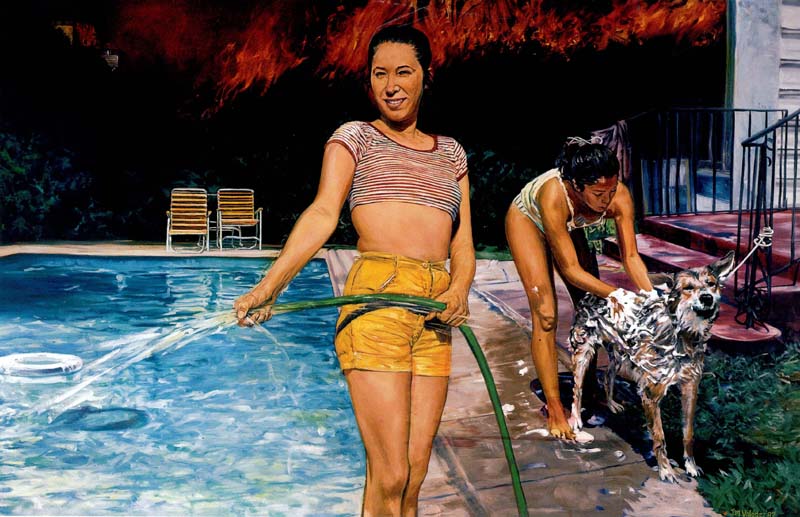
With work spanning four decades, the exhibit reveals the incremental development of the artist’s vision.  In the 1970’s he was assembling collages of newspaper clippings at the same time he was making  black and white photographs of Mexican Americans  posing for him on the street  Then he switched to color film -  and then he made large, sometimes life size,   drawings from the photographs.  By the mid 80’s he was painting complex narratives that feel like photographic records of things both real and fantastic. The highlight of this period is a monumental pastel entitled “Pool Party” (1986), depicting two young Latin women behind the house grooming the family dog and hosing down the edge of the pool, apparently unconcerned with the nearby hills that are ferociously burning behind them. Hey girls! Wake up and smell the smoke!  There’s that gentle sense of humor in the later narrative work as well, some of it more fantastic, others less so.


Dulces, 1999


 He depicts a world that’s awkward, funny, and brimming with hope and excitement, but not especially elegant or profound.  And unlike  the leading American figure painters of that period, like Eric Fischl, the characters in his paintings feel as innocent as the noble peasants depicted by an earlier generation of Mexican artists.

Tomoaki Suzuki at the Art Institute


Tomoaki Suzuki – Roehm Terrace, Art Institute, through Oct. 27 


It doesn’t look like Japanese artists are ever going to shake their aesthetic inclinations however alien they might be to the provocative anti-aesthetics of contemporary art. Tomoaki Suzuki can’t stop himself from making his 20-inch statues look really good, even if he places them on the floor where it’s difficult to discern their quality.


He makes expressionless polychrome figures that in many ways resemble the carefully detailed dolls one might find in Japanese gift shops. It’s just that instead of pretty Geishas in kimonos, he represents the handsome young people of his London neighborhood in the kind of clothing that expresses their individuality. By placing them directly on the floor, he offers the thrill of the incongruous, but he’s not just a skilled model maker, or a conceptual artist who hires one.


 Katsura Funikoshi


 He’s in a tradition of figure sculpture, as received from his teacher, Katsura Funikoshi, whose father was also a sculptor. Though enhanced by the fluid naturalism of Rodin and late 19th C. France, this tradition remains essentially Japanese in its straightforward inner strength as achieved by the execution of crisp planes carved across the surface. He has created a specific posture, character, and costume for each person, but though great attention has been paid to every eyelash and belt buckle of his British models, they have a distinctly Japanese elegance and attitude. And the paint has been applied with a sensitivity to color and pattern more than to specify details of costume. Like many Japanese sculptors over the past thousand years, Suzuki is a wood carver, though in this display, the carvings have been cast in bronze, allowing them to be displayed in an outdoor setting like the Roehm Terrace high atop the Modern Wing at the Art Institute. And what a magnificent setting it is! – offering the magnificent steel and glass skyline that rises just north of Grant Park.


 Even the largest sculpture can feel dinky on that heroic, sunlit platform – but surprisingly Suzuki’s figures feel large and important, even if you have to crawl around on your hands and knees to properly see them. It’s a good bet that eventually his work will be displayed up on pedestals, allowing viewers to properly see it without scuffing their knees. That may defy the artist’s original intention, but perhaps that intention was only to display it in the way most suitable to attract the contemporary art world.

Saturday, March 30, 2013

Michael Van Zeyl at Gallery 180


Michael Van Zeyl at Gallery 180, through May 2


Morbidity is stalking the Classical Realism of our time with figures as perfectly life-like as they are lifeless. But Michael Van Zeyl has a much lighter touch His settings resemble hotel banquet rooms – well appointed with fruit, flowers, crockery, and furniture but far removed from palatial elegance. And the attractive young women he portrays seem healthy and lively, though not especially remarkable or profound. Something seems to be happening, but it’s their own private secret, and whether happy or sad, it will probably pass as quickly as a summer shower. The stage has been set for a comedy of manners.


This kind of painting is far removed from the Surrealism of the Chicago school, which is why it so badly needs to be shown here. The people and scenes depicted are just as contemporary. It’s just that the angst or quirkiness of the artist is not in your face. Instead, you feel skill, intelligence, balance, and wit behind the stage, making careful arrangements. Compared with the great masters, his painterliness comes up short, and is not strong enough in his still lifes to provoke a sense of wonder. But wherever figures are added, his painting becomes intriguing.